
Searching for an SEO company in Castle Rock turns up a strange mix: Denver agencies with a Castle Rock landing page, national firms with a call centre, a few genuine locals, and a lot of companies whose own websites do not rank for anything.
This guide is about how to tell them apart. Not a list of names, because a list of names goes stale and half of them will be the same three people trading under different brands by next year. What does not go stale is the set of questions, and the questions are unusually good at sorting this particular industry.
I run one of these companies, so read the rest knowing that. I have tried to write the guide I would want if I were hiring somebody else.
Why Castle Rock Is Different From Denver
Castle Rock is a smaller, thinner market than the metro, and that changes the maths in your favour.
In Denver you are competing against several hundred agencies who have been targeting the same terms for a decade.
In Castle Rock a handful of local businesses target their own town properly. Most of the rest have a Google Business Profile that was set up once and never touched again.
The map pack rewards proximity to the person searching. A Castle Rock business competing for Castle Rock searches is fighting a short list. The same business trying to rank across the whole metro is fighting everybody and will lose.
That is the same reason a growing market is cheaper to enter than a finished one, and why the advantage has a shelf life.
That is the single most useful thing to know before you spend anything: the winnable market is smaller than the one you were probably about to buy.
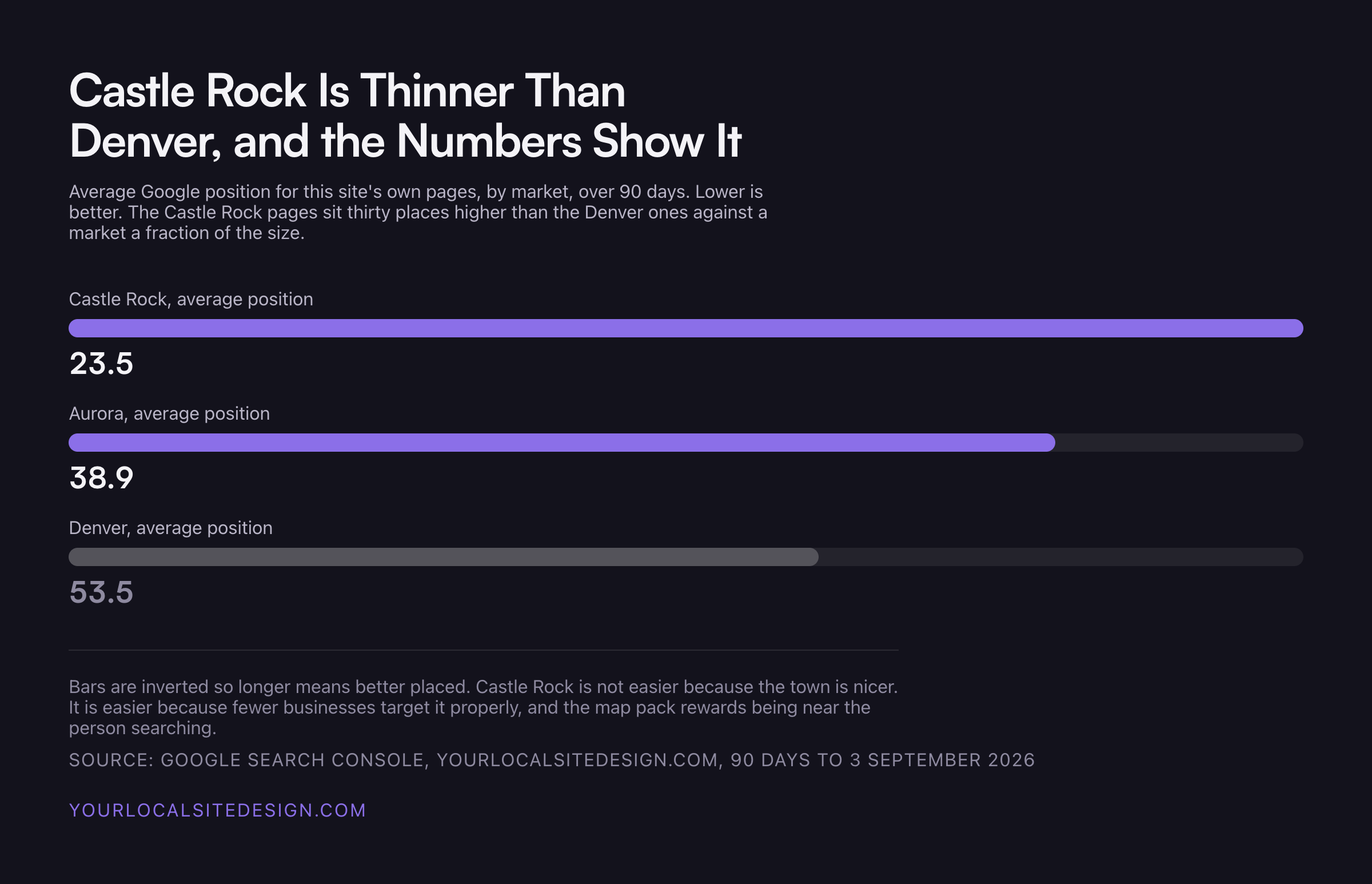
Those are my own numbers rather than a study, taken from this site's Search Console. The Castle Rock pages sit thirty places higher than the Denver ones. Same site, same person writing them, same amount of effort. The market is the difference.
The Five Questions That Sort Them Fast
1. What will I still own in twelve months if I stop paying you in month eleven?
This is the question that separates activity from assets, and it is the one most likely to produce an uncomfortable pause.
An agency selling activity bills you for hours, audits and reports. At the end of a year you own a stack of PDFs.
An agency building assets leaves you with pages that are indexed, a profile that is built out, and reviews that exist whether or not you renew.
Both feel similar month to month. Only one of them is worth anything when the invoicing stops.
2. Can you show me the rankings and the call log for the same six months?
Rankings are easy to send. Call logs are not, which is exactly why this question works.
Any agency can produce a report full of green arrows. Very few can put that report next to the client's Google Business Profile call count for the same period and show the two moving together.
Ask for both. The reluctance, if there is any, tells you more than the answer would have.
3. Whose name are the accounts in?
Your domain, your hosting, your Google Business Profile, your call tracking number. All of them should be registered to you from the first day, not held by the agency and released on request.
This is an ugly habit in the industry rather than a rare one. Profiles registered under an agency account mean firing them costs you the asset. Ask before you sign, not after.
4. What is the number, and is it on your website?
If the price only appears after a sales call, the price is being set by what you look like you can afford rather than by the work.
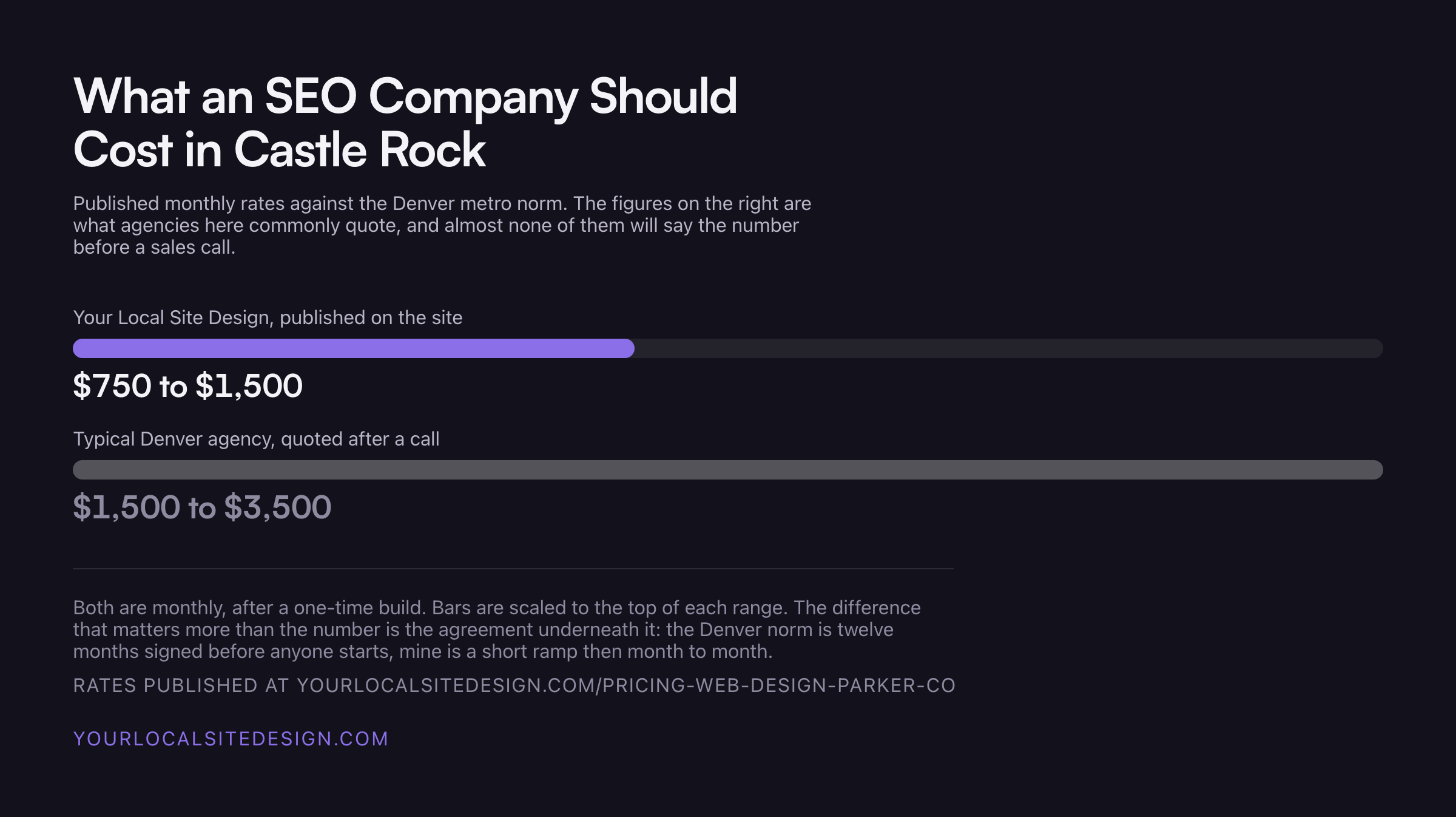
For reference, mine are published: $1,500 to $6,500 for the build, then $750 to $1,500 a month. Denver agencies commonly quote $1,500 to $3,500 monthly on a twelve month agreement, and most will not say a number out loud beforehand.
5. How long, honestly?
The right answer is unexciting. Lower competition terms move inside one to two months. Call volume worth talking about lands around month six. A full return takes roughly a year of steady work.
Anybody promising page one in thirty days is either bidding on terms nobody searches or describing something that does not happen.
The One Hour Check on the Company You Already Have
If you are already paying somebody and the phone has not changed, run this before you read anything else. It costs nothing, needs no access to anything your agency holds, and they cannot see you doing it.
- Pull the ranking report you get each month.
- List every term where you sit in the top three.
- Look up the monthly search volume behind each one.
- Add the volume up, then compare the total to your calls.
If the volume is tiny, the rankings are decoration. Every line on that report can be true and the whole document can still be describing nothing.
This is the most common way a local business gets quietly overcharged, and it is rarely dishonest.
It is what happens when the thing being sold is activity. Activity has to be evidenced somehow, and a report is the cheapest evidence there is.
What Good Work Actually Looks Like Here
In rough order of what moves first:
- The Google Business Profile, rebuilt. The primary category alone is the biggest single lever in the map pack and the item most often left the way it was set on day one. It is free to fix and it can move you in weeks.
- A page for every service you sell. One combined services page cannot rank for six different jobs. This is the part people most want to skip and the part that decides the outcome.
- A page for every town you actually drive to. Real pages about work you have done there. Not one page duplicated with the town name swapped, which has a name at Google and works against you.
- Reviews asked for systematically, at the moment the customer is happiest, with the job and the town named in the wording.
- One number reported back. The calls your profile and your site produced. Not impressions, not average position.
Where I Fit, and Where I Do Not
I am fifteen minutes up the road in Parker, and I do SEO in Castle Rock specifically. Flemings Tree Care is a Castle Rock client. Before me, three separate agencies had been paid, and what came back every month was a report.
I am a good fit if you want the site and the search work run as one thing, you want the price on the page before the call, and you would rather have a small number of pages that rank than a large monthly retainer.
I am the wrong fit if you need a large team, national campaigns, or e-commerce at scale. If that is you, I will usually know somebody worth talking to.
And if you would rather do this yourself, the checklist above is the whole job. Run the one hour check first. It is the fastest way to find out whether you have a ranking problem or a reporting one.