
Web Design Near Me, in Colorado
What "near me" actually means to Google, why proximity matters more than most agencies admit, and how to tell a local designer from a national one with a local landing page.
48 hours, no call required.
$1,500 to $6,500 one time, published rather than quoted after a call. Anything at $500 is a template with your logo on it.
One of the most searched phrases in this business and one of the least useful, because the results change depending on where you are standing.
Near Me Is About You, Not About the Words
Google reads it as your current location and largely ignores the phrase itself. Two people typing the same thing three miles apart get different results.
That is why nobody ranks for it everywhere, and why anyone promising to is describing something that does not exist.
It also sets a ceiling worth knowing before you buy anything. You can win the area around your address. You cannot win the whole metro in the map pack, because the pack is recalculated for wherever the searcher is standing.
What has no proximity limit is organic search, and that is the half most local companies never buy, because nobody explained the difference. It is also the half that decides whether web design for local businesses is worth anything, because a site with one services page has nothing for it to work on.
The Questions Worth Asking Anyone, Me Included
Who owns the domain?
If the answer is not you, stop there. Getting it back later costs a fee and a fortnight, and the moment you most need it back is the moment you are least able to wait.
Is there a lock-in?
Twelve month agreements are standard in Denver and are not necessary. A build is a project with an end date, and a monthly service you cannot leave is a monthly service that stopped having to earn it.
What is the price, in writing, before starting?
A number that only appears after a call is a number that moves, and it moves toward whatever the call suggests you can afford.
Who actually does the work?
The person who sold you is often not the person who builds it. That is not automatically bad, but you should know it before rather than after, because it decides who you talk to when something needs changing.
Can I see live sites in my trade?
Clickable, still online, in a trade near yours. Screenshots are not proof, and a portfolio full of sites that no longer exist is telling you how those relationships ended.
What happens if I leave?
Ask before you sign, with me or anyone else. The answer should be that you keep the domain, the hosting, the content, the images and the Google profile, and that access moves within a business day.
National Companies Buy Local Landing Pages by the Hundred, So Your Town in the Headline Proves Nothing
This is the actual problem with searching for anything near me. The results are full of pages that name your town and belong to a company that has never been in it.
The tells are unglamorous. A real street address rather than a PO box. A local number rather than a toll-free one. Named clients in towns you recognise, not unnamed clients in other states. Live sites you can click. A person who answers the phone themselves.
The other side of the page looks like this: your town in the headline and nothing else local, stock photography of a generic office, a contact form and no phone number, and everything by email, always.
Now, does it actually matter whether they are local? For building the site, no. Code does not care where it was written and plenty of good work is done remotely.
For local search it matters more than people expect. Somebody working in your market knows which towns are realistically winnable from your address, which neighbourhoods get searched by name, and which competitors already hold the pack.
That is knowledge rather than proximity. It just tends to come from proximity.
So hold me to the test I just wrote. I am in Parker and I work across the south Denver metro.
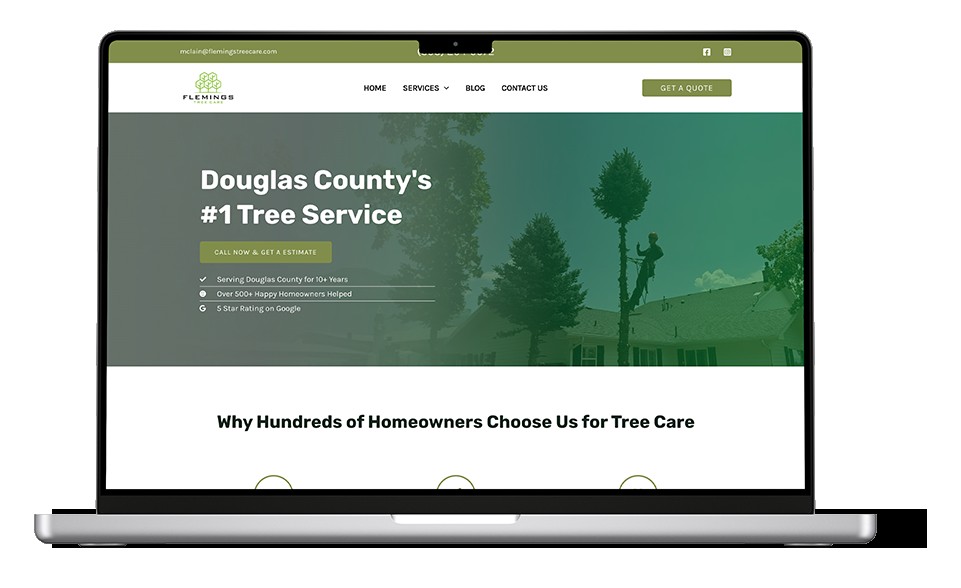
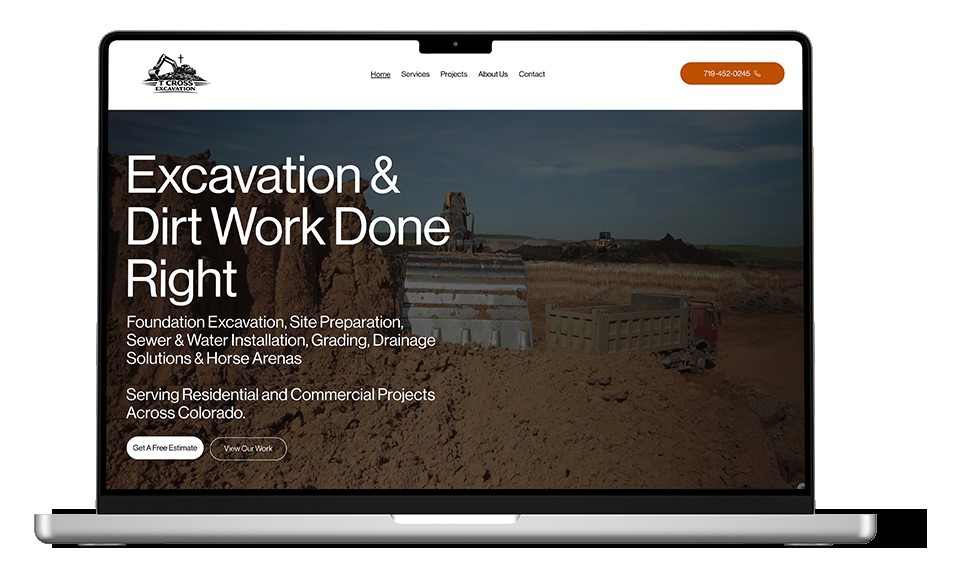
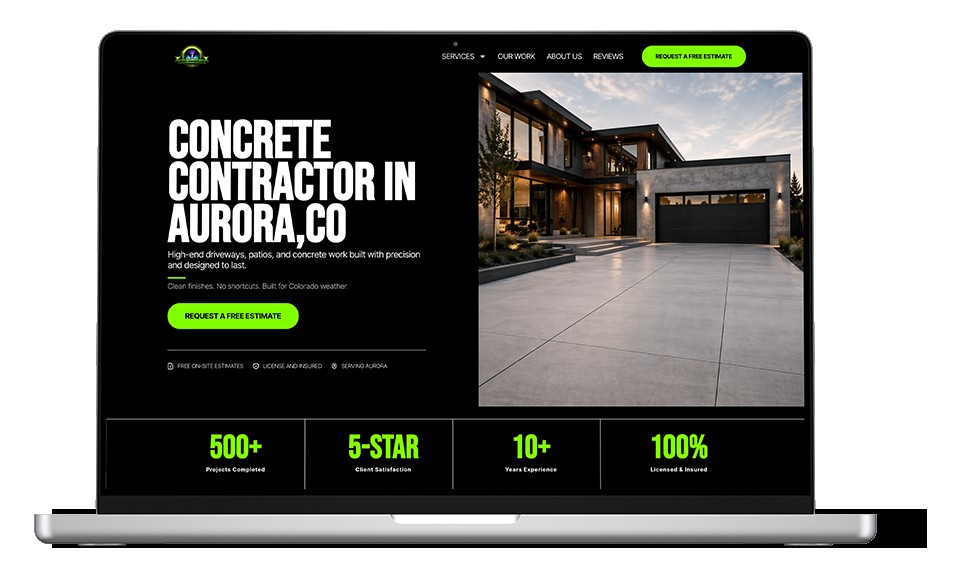
Flemings Tree Care in Castle Rock, an electrician in Highlands Ranch, T-Cross Excavation, Legacy Concrete and Applied Technology Inspections are each a real client with a real site, and every one is reachable from the homepage.
The client who has stuck with me longest passed the three year mark a while back, which says more than anything else I could write in this section.
I told you to demand live sites you can click and check, so the same rule applies here. The work is on the trades page with names attached, and if your trade and town are already taken I will say so rather than book a call.
How It Works
The teardown.
$47. Who ranks near you, what their pages answer that yours does not, and whether the honest answer is a clean-up rather than a rebuild.
Interview.
Forty minutes on what you sell and which towns you actually drive to. That decides which of them are winnable in the pack and which are organic reach.
Build and launch.
Written, built, tested on real phones, redirects mapped from the old site, then live. Every account registered to you before launch day rather than after.
One number.
Calls counted monthly. If you want the detail underneath it, it is there, but the headline is the figure that pays your bills.
What It Should Cost Around Here
$1,500 to $6,500$1,500 at the low end for a custom three page site, $6,500 at the top for a twenty page build, and the middle of the bell curve for local service businesses sits at $3,500.
Anything at $500 is a template with your logo dropped in. Anything above this range for an eight page service business site is usually paying for somebody's office.
The full breakdown is published rather than quoted after a call. If a quote is framed as website development rather than a website, that distinction is worth understanding first.
Questions I Get Asked
Does my web designer need to be local?
For building the site, no. Code does not care. For local search work it helps, because someone in your market knows which towns are winnable from your address and which are not.
What does Google mean by near me?
Google reads it as your current location rather than the words themselves. Two people typing the same phrase a few miles apart get different results, which is why nobody ranks for it everywhere.
How do I tell if a company is actually local?
Look for a real address rather than a PO box, a local phone number rather than a toll-free one, and named clients in towns you recognise. National companies buy local landing pages, so the page saying your town proves nothing on its own.
How much should a local website cost?
In this market, expect $1,500 at the low end for a custom three page site and $6,500 at the top for a twenty page build. The middle of the bell curve for local service businesses sits at $3,500. Anything at $500 is a template with your logo on it.
Should I use a national platform instead?
You can, and for some businesses it is fine. What you give up is anyone who knows your market, and template sites tend to be slow and hard to rank because you cannot change what loads.
What questions should I ask any designer?
Who owns the domain and hosting. Whether there is a lock-in. What the price is, in writing, before starting. Who does the work after the sale. Whether they can show live sites in your trade.
Can you rank me for near me searches?
Partly. Those searches are decided largely by proximity, so you can win the area around you and not the whole metro. Anyone promising the metro is describing something that does not exist.
Do you work outside the south Denver metro?
For the website itself, yes, anywhere. For map pack rankings, proximity decides a lot, so I am most useful to businesses in the south metro.
What if I already have a site?
Send me the address. Often the answer is a clean-up rather than a rebuild, and I will say so.
Who owns the site when it is done?
You do, completely. The domain, hosting, content, images and every login get registered to you the day the project starts, which means there is never a handover fight later.
Where I Work
Based in Parker, Colorado, working across the south metro. Which of these towns is realistically winnable in the map pack depends on where your address sits, and that is a conversation rather than a checkbox.
Start With the $47 Teardown
I'll show you who actually ranks near you, which of them are local and which are landing pages, and what it would take to sit above them. Forty-eight hours. Yours to keep either way.
$47, free if you go ahead with any service. If you do not see an increase in calls by month three, I work for free until you do.
Your Local Site Design LLC
1394 Deertrack Ln
Parker, CO 80134
(303) 981-0908