
Somebody typed "seo" into Google, and Google's own "people also ask" data shows what came back: four big questions, each one branching into three to six smaller ones. That is not a random list. It is what people actually want to know, in the order they want to know it.
So here they are, answered one at a time, straight, with the source named under every number. Not an original study. Just the best answer to each question I could find, put in one place, so you do not have to open nine tabs to get it.
What Exactly Does SEO Do?
SEO, short for search engine optimisation, makes a web page easier for Google, and now AI assistants, to find, understand and trust enough to show someone searching for what that page answers. It does not buy a ranking the way an ad buys a slot. It removes the reasons a page would be skipped: slow to load, unclear what it is about, nothing backing up its claims, or simply never seen by the search engine in the first place.
That is the whole job in one sentence. The six questions under it are where people actually get stuck.
How Is SEO Used in Marketing?
As the channel that earns attention instead of renting it. Content marketing and SEO together now take 25 to 30 percent of the average marketing budget in 2026, more than any single paid channel, because a page that ranks keeps bringing people back without a new payment each time an ad does. SEO also costs about $31 per lead against roughly $181 for a paid search lead, call it 5.8 times more leads for the same dollar, which is why it usually sits at the center of a small business's marketing rather than off to the side.
Is SEO Still Worth It in 2026?
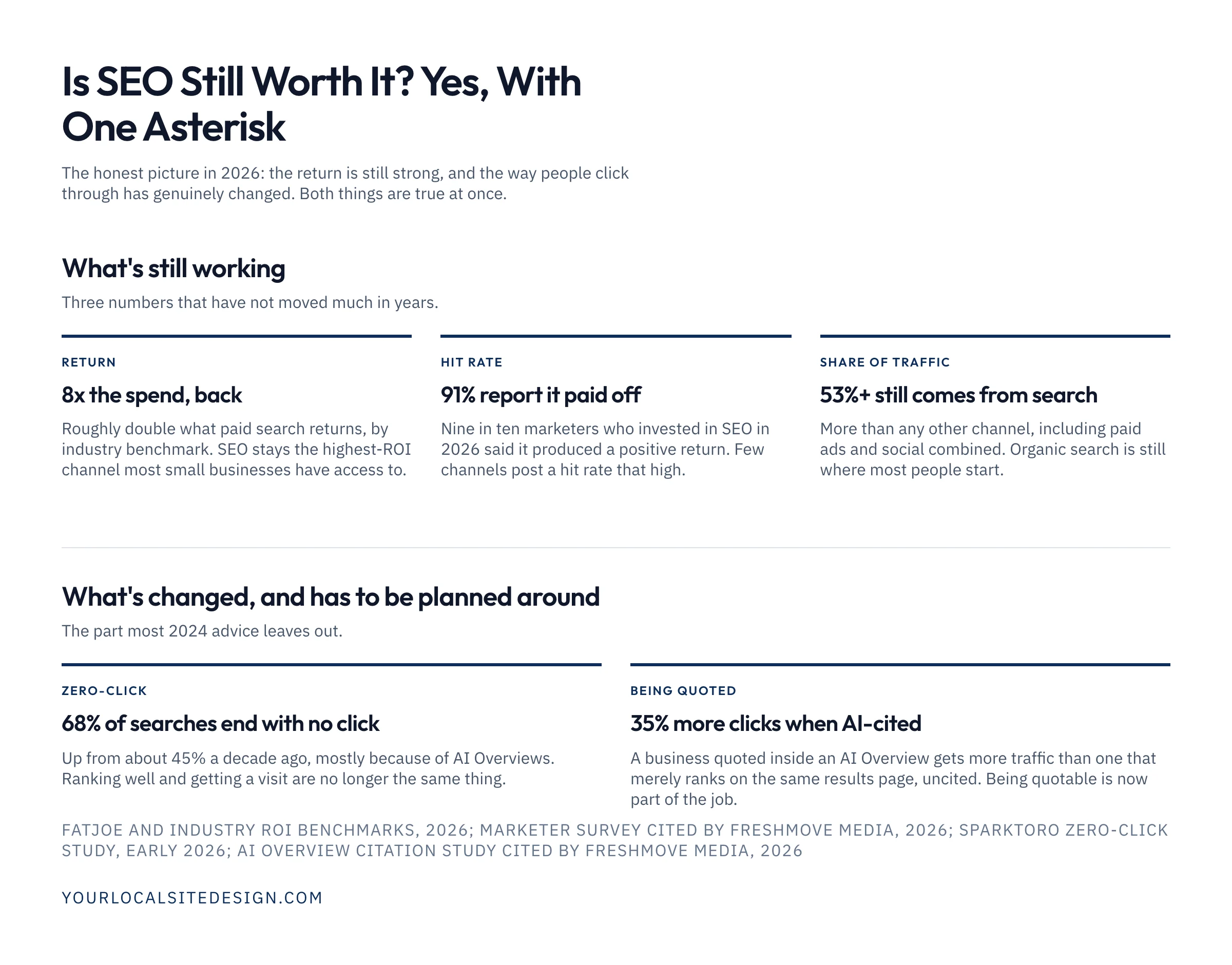
Yes, with one real asterisk. SEO still returns about 8 times what gets spent on it, roughly double what paid search returns, and 91 percent of marketers who invested in it this year reported a positive return. Organic search still brings in more than 53 percent of all website traffic, more than every other channel combined.
The asterisk: 68 percent of Google searches in 2026 end without anyone clicking anything, up from about 45 percent a decade ago, mostly because of AI Overviews answering the question directly at the top of the page. Ranking well and getting a visit used to be the same thing. They are not anymore. The businesses still winning are the ones whose content gets quoted inside those AI answers, which produces about 35 percent more clicks than ranking on the same results page without being cited.
FatJoe and industry ROI benchmarks, 2026; marketer survey cited by FreshMove Media, 2026; SparkToro's zero-click study, early 2026.
Can I Do SEO Myself?
Yes. A large share of small business owners already do. It takes 15 to 24 hours a month according to two separate surveys, which is the honest cost of doing it yourself: not dollars, your own time. If you value that time at, say, $75 an hour, 15 hours a month works out to roughly $1,125 of your own labour, which can land close to or past what a professional costs. Whether DIY makes sense is a question about what else that time is worth to you, not about whether the work itself is too hard.
Is SEO Paid or Free?
Both, genuinely. The core tools cost nothing: Google Search Console, Google Business Profile, Google Keyword Planner and Bing Webmaster Tools are all free with a Google or Microsoft account. What costs money is time, either yours or someone you pay to spend theirs. There is more detail on exactly which free tools matter further down this page.
Is SEO Dead Now With AI?
No, but its job changed. AI Overviews favor content that was already ranking well in a normal search, and backlinks remain the single strongest input into what gets picked. SEO did not get replaced by AI search. It became the raw material AI search runs on. A page with no SEO behind it has nothing for an AI Overview to find, let alone quote. That is also the whole argument behind AI SEO in Denver, which goes much deeper into how ChatGPT and Google's AI Overviews actually pick who to name.
Is SEO Difficult to Learn?
The mechanics are not hard. Writing a clear page, filling out a Google Business Profile completely, fixing a broken link: none of that needs a certification. What is genuinely difficult is doing it consistently for long enough to see it work, because results take three to six months to show and six to twelve to stabilize, and most people give up inside month two, right when the data is still too thin to tell them anything.
How Can I Start SEO as a Beginner?
Pick one page, fix the things on this page in order, and measure it for ninety days before touching anything else. That is the whole starting move. The four questions under this one are about what that actually requires.
What Are Basic SEO Skills?
Four of them cover almost everything a beginner needs: writing a page that answers one specific question clearly, reading a Google Search Console report well enough to see which pages get found and which do not, filling out a Google Business Profile completely and keeping it current, and asking for and responding to reviews. None of the four require code.
What Is SEO Salary?
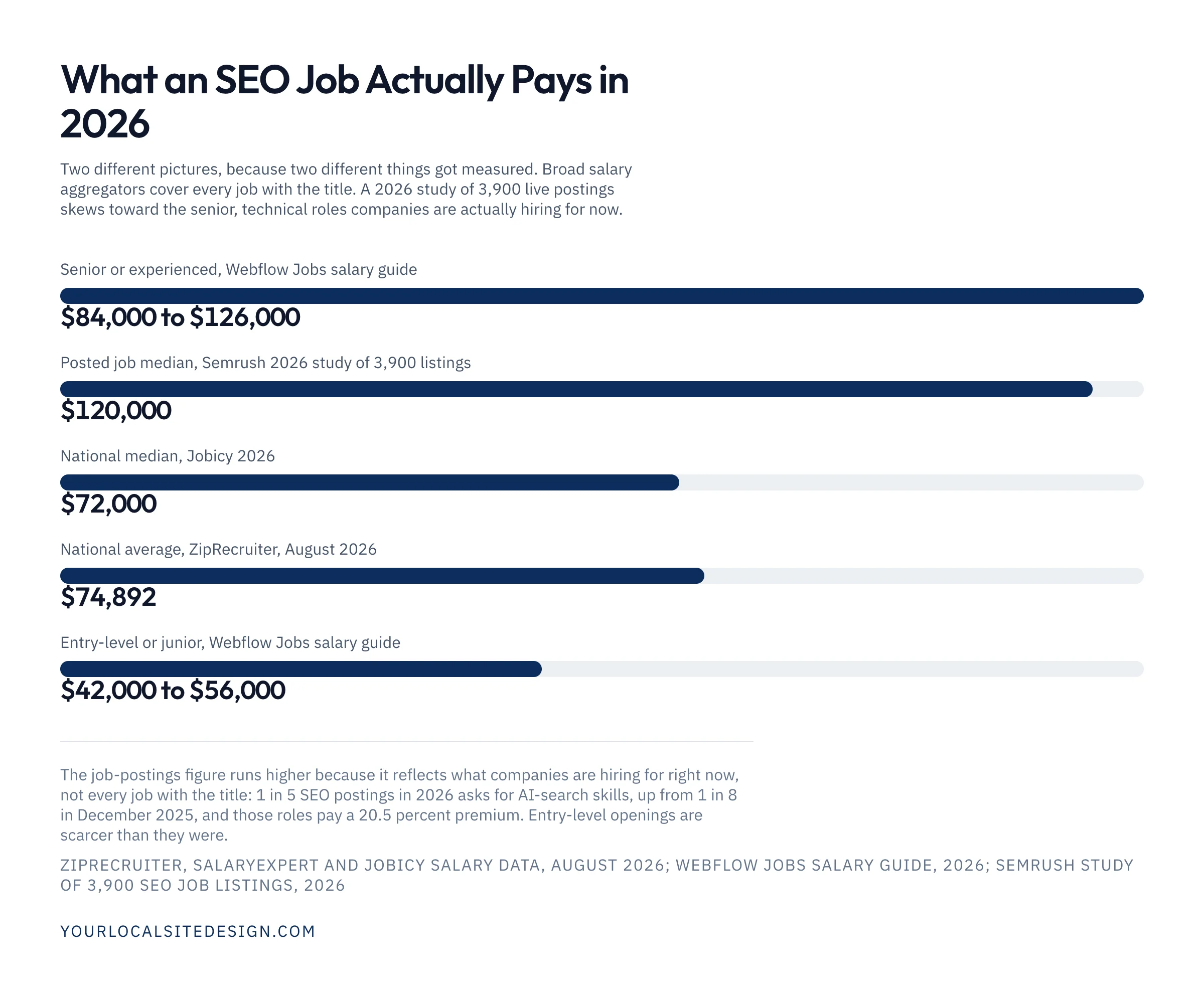
It depends heavily on which number you are looking at, and almost nobody explains why they disagree. Broad salary sites that average every job with the title "SEO Specialist" put the national figure at $67,000 to $75,000 a year. A 2026 study of 3,900 live job postings found a median of $120,000, because that study measured what companies are actually hiring for right now, which skews senior and technical. One in five SEO job postings in 2026 asks for AI-search skills specifically, up from one in eight in December 2025, and those roles pay about 20.5 percent more than ones that do not.
ZipRecruiter, SalaryExpert and Jobicy salary data, August 2026; Webflow Jobs salary guide, 2026; Semrush's study of 3,900 SEO job listings, 2026.
What Is the 80/20 Rule in SEO?
The idea, borrowed from the Pareto principle, that roughly 80 percent of a site's organic traffic comes from about 20 percent of its pages or keywords. In practice that means a site with a hundred pages is probably getting most of its calls from twenty of them, so the useful move is finding which twenty those are and improving them, rather than spreading equal effort across all hundred.
How Do I Learn SEO as a Beginner?
By doing the free version of the job on your own site before paying anyone to do it for you. Set up Google Search Console, read what it tells you about your own pages for thirty days, then fix the single biggest problem it shows you. Repeat that loop and you will learn more in three months than any course teaches in one, because every lesson is attached to your own real numbers.
Can ChatGPT Do SEO?
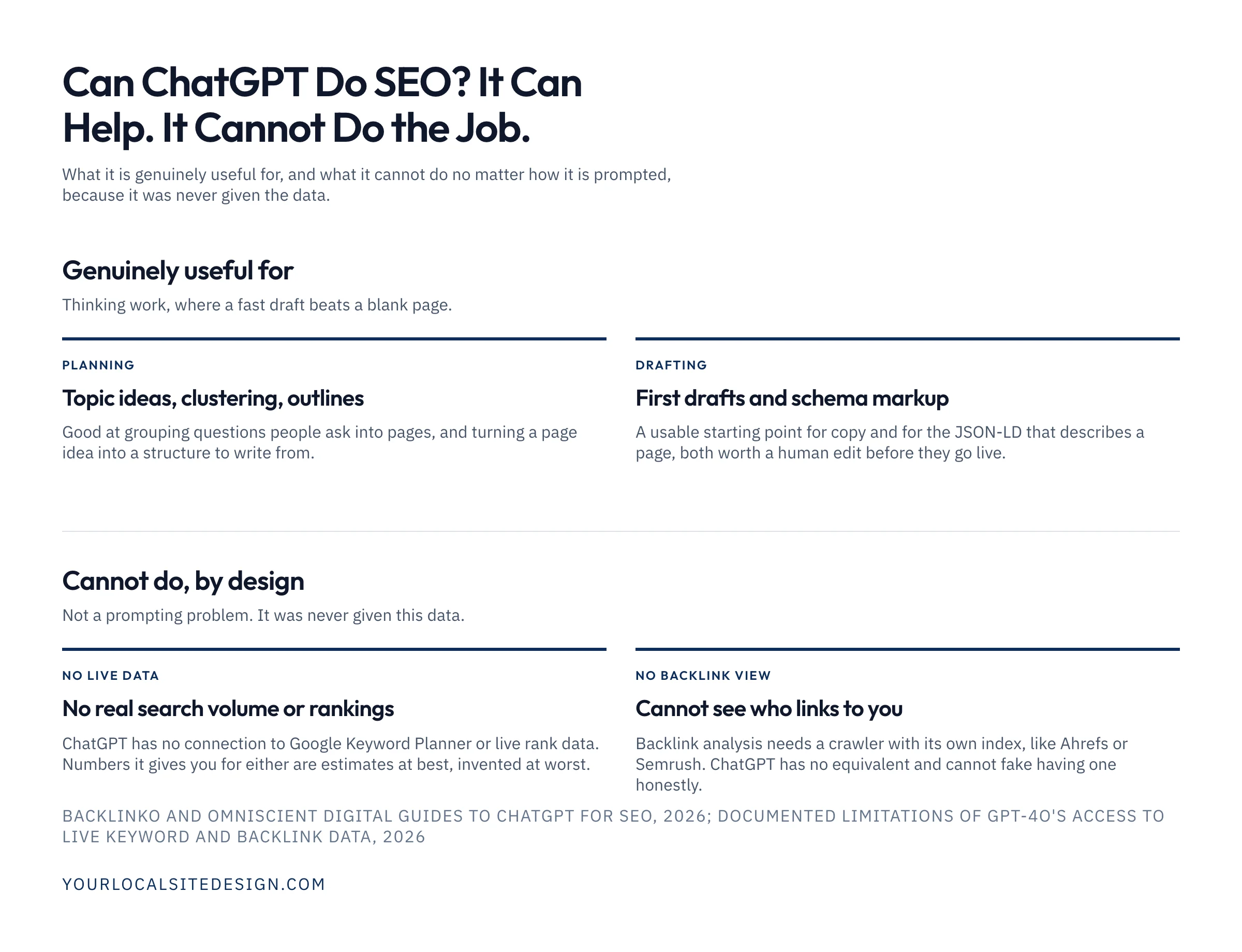
It can help with the thinking. It cannot do the job. ChatGPT is genuinely useful for topic ideas, grouping related questions into pages, and drafting a first pass at page structure or schema markup. What it cannot do, because it was never given the data, is tell you real search volume, real rankings, or who actually links to your site. Numbers it gives you for any of those three things are estimates at best and invented at worst.
Backlinko and Omniscient Digital guides to ChatGPT for SEO, 2026.
Which AI Is Best for SEO?
None of them replace a dedicated SEO tool, and anyone selling you otherwise is selling you the exciting answer over the correct one. ChatGPT is strongest for writing and ideation. Purpose-built tools like Surfer SEO and Clearscope hold their own data on what is actually ranking, which is the part ChatGPT cannot do. The honest setup most people land on is ChatGPT for drafting, a real SEO tool for the numbers.
What Is Replacing SEO?
Nothing is replacing it. It is splitting into two jobs that overlap heavily: ranking in a normal search, and being the kind of clear, well-sourced page an AI assistant is willing to quote. Both jobs want the same things underneath, specific answers, real reviews, consistent business details, which is why doing SEO properly is still most of what it takes to show up in an AI answer too.
Is It Hard to Get a Job in SEO?
Harder at entry level than it was. The center of the job market has moved up: fewer pure junior roles, far more postings that expect real experience already, and a growing share asking specifically for AI-search skills. LinkedIn still lists more than 10,000 open SEO roles in the US and layoffs nationally are at a four-year low, so the field is not shrinking. It is just asking more of the people getting hired into it.
Can I Do SEO for Free?
Yes, with real tools, for genuinely zero dollars. The part nobody tells you is which free tool matters most and why almost nobody sets it up.
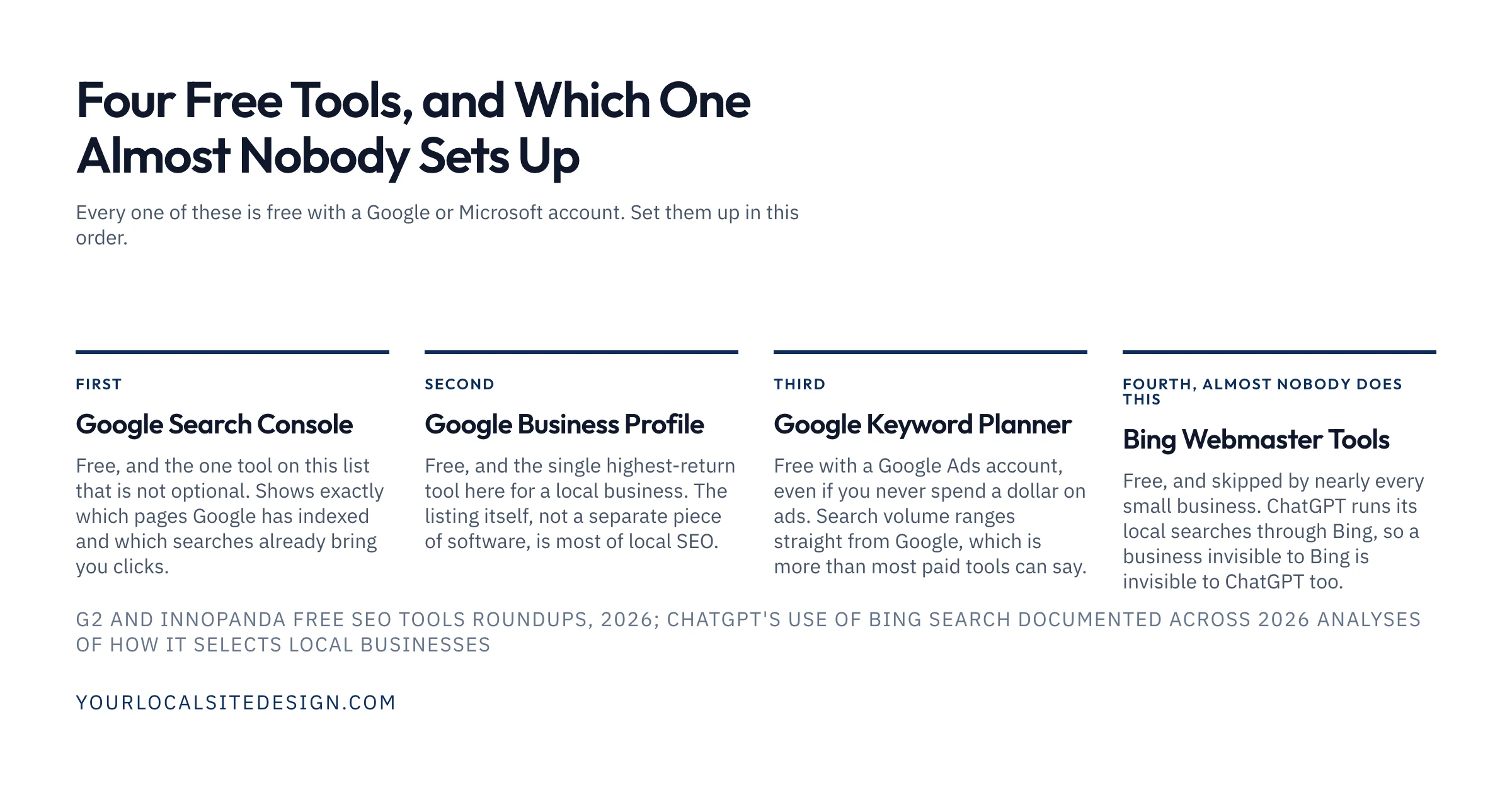
G2 and Innopanda free SEO tools roundups, 2026; ChatGPT's use of Bing search for local questions, documented across 2026 analyses of how it picks which businesses to name.
That last one is the one worth pausing on. ChatGPT does not answer local questions from memory. It runs a live search through Bing and reads what comes back. A business that has never claimed its Bing Places listing or opened Bing Webmaster Tools is, for that search, invisible, no matter how well it ranks on Google. It is free, it takes about ten minutes, and almost nobody who is not already deep into this topic has done it.
Can I Do SEO Myself for Free?
Yes. Every tool in the graphic above costs nothing, and together they cover indexing, your Google listing, keyword research and whether ChatGPT can even see you. What is not free is the time it takes to use them consistently, which is the real trade-off behind every answer on this page.
Can I Do SEO Without Paying?
Yes, for the mechanical parts: the tools, the listing, the technical fixes. What tends to cost money eventually is content at scale and backlinks from other sites, because both usually need either your own sustained hours or someone being paid for theirs. There is no tool that writes forty honest, specific pages for you and no free way to make another website decide to link to yours.
What Is the Best Free SEO Tool?
Google Search Console, by a wide margin. It is the one tool on the list that is not optional: it shows exactly which pages of your site Google has indexed, which searches already bring people in, and which pages are being ignored entirely. Everything else on this page is easier to prioritize once you have read what it tells you.
What This Actually Costs, DIY or Hired
Put the time and the money side by side and the real decision gets clearer. Doing it yourself at 15 hours a month is worth roughly $1,125 of your own time at a $75 hourly rate, which is a real number even though no invoice ever shows up for it. Hiring it out nationally runs $500 to $5,000 a month depending on how competitive the market is, with the average agency at $3,200 and the average freelancer at $1,350.
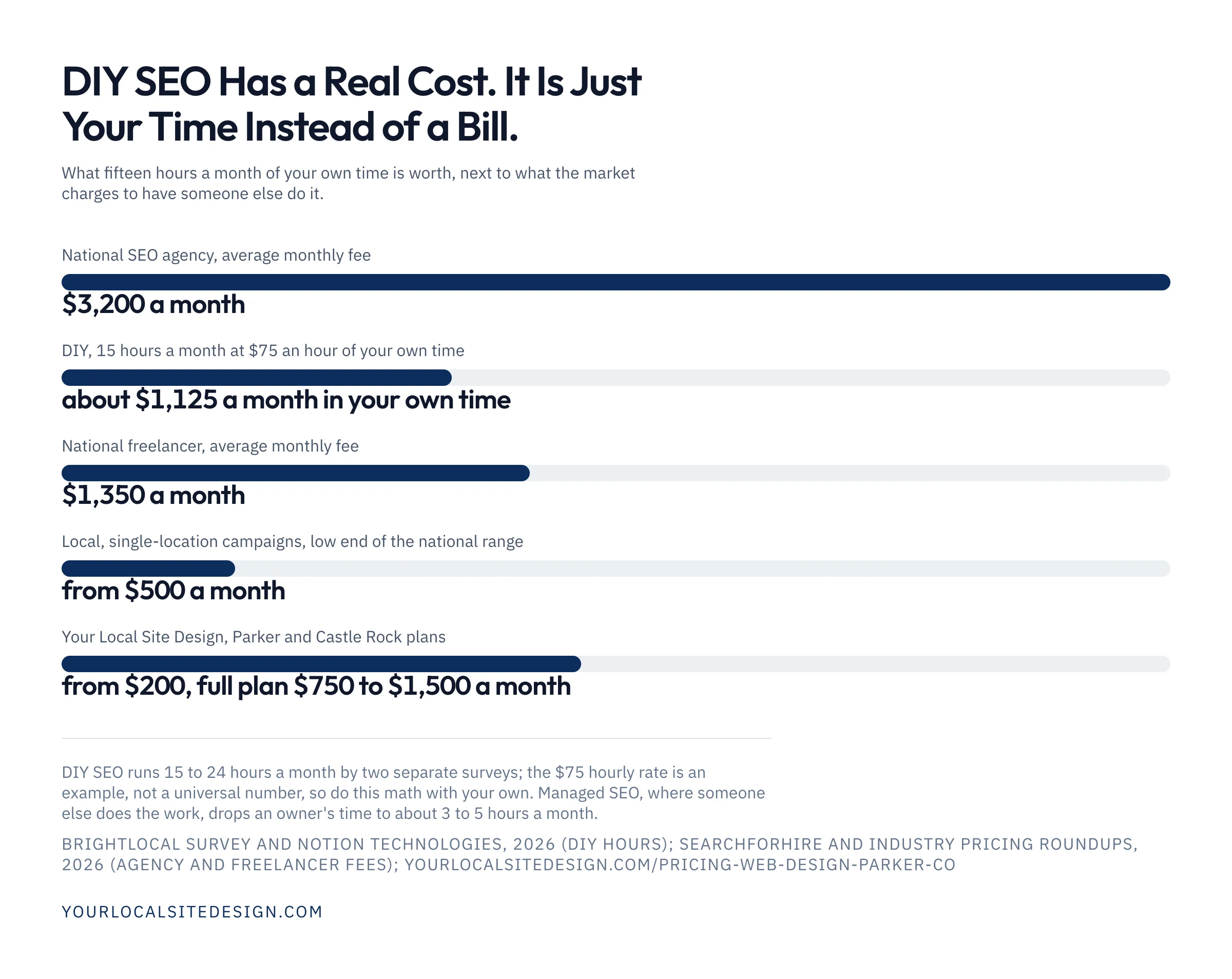
BrightLocal survey and Notion Technologies, 2026, for DIY hours; SearchForHire and industry pricing roundups, 2026, for agency and freelancer fees; the published pricing page here for the one local number on the chart.
That last row is the one number on this page that is mine rather than borrowed: what I charge in Parker and Castle Rock, published rather than quoted after a call. A one-time build runs $1,500 to $6,500 depending on page count, and the monthly SEO plan runs $750 to $1,500 once you are past the $200 starting tier. It is lower than the national range mostly because it is a smaller market with less competition for most trades, not because the work is different. Worth knowing before you compare any quote against the national figures above.
Where to Go From Here
If you read all of that and landed on do it yourself, start with Google Search Console this week and come back to this page in ninety days. It will make more sense the second time, once you have your own numbers to check it against.
If you read it and landed on hire someone, the two honest next steps on this site are local SEO, which is the work itself laid out plan by plan, and AI SEO in Denver, which goes deep on the specific part of this page about ChatGPT and AI Overviews. For Parker and Castle Rock specifically, SEO in Parker and SEO in Castle Rock carry the real client numbers and the month-by-month plan.