
If you own a water purification or water filtration company and you install for homeowners, the Google map pack is where your best leads are sitting. It is the box of three businesses with a map near the top of the results. The person searching it has a problem today, they are not browsing, and in my experience they close far better than a sponsored click, because the intent is so high.
So I did the thing I do on every teardown, out loud. I searched for a water purification company from my house in Parker, Colorado, looked at who made the map pack, and then worked out why they were there and why a company a few minutes from me was not. Everything I checked is free. The video shows every click, and the written version is below it so you can run the same checks on your own market.
Step One: Find Out What People Actually Type

Most owners I talk to do not actually know how customers find them. They have a guess. Two free tools replace the guess.
Google Ads Keyword Planner, with no money in the account. Create a Google Ads account, do not fund it, open Tools and then Keyword Planner. Type the phrases you think people use and it returns a long list of searches other companies are paying for. I sort that list by the top of page bid, highest first. The phrases people bid the most on are the phrases that are converting for them. Those few words belong all over your website and your profile.
Google Search Console, if you have it. It shows the exact phrases people typed before they landed on your site and what they clicked. Often it is your company name. Sometimes it is a phrase you never thought of. One of our tree service clients was getting clicks for "arborist," a word that was nowhere on the site until we saw it there. If you have never set Search Console up, the DIY ranking guide walks through it.
Step Two: Read the Three Profiles That Beat You
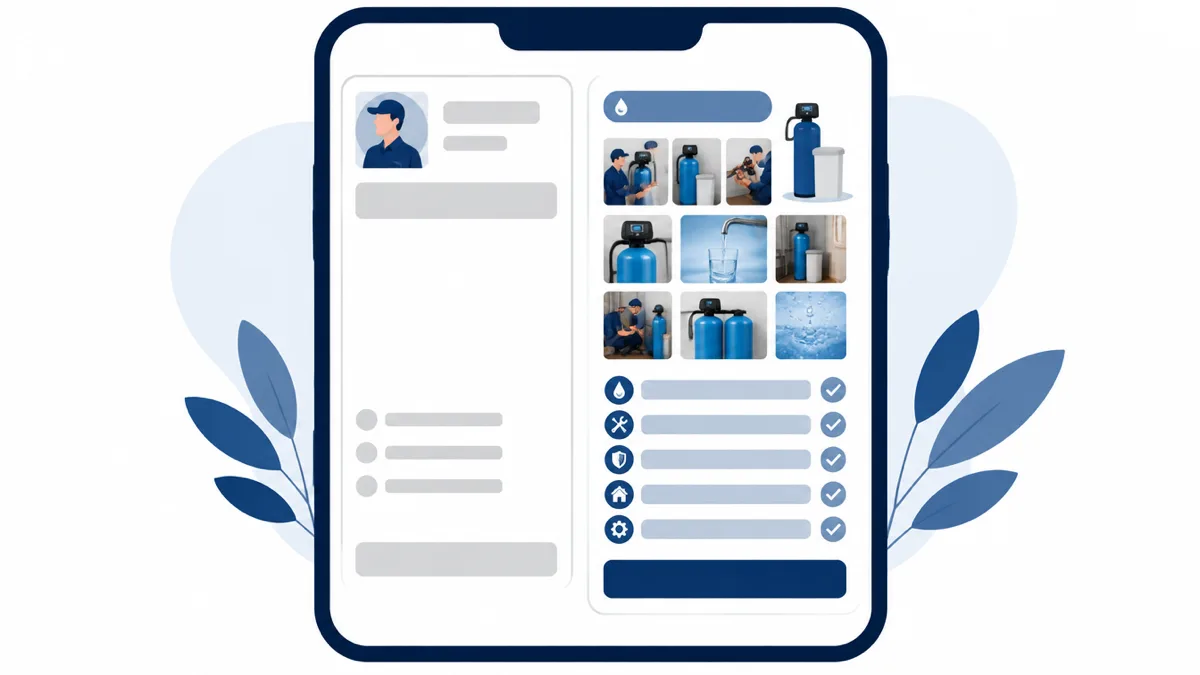
The first thing I noticed is that Google did not show me the companies closest to my house. It showed me what it believed matched the search. One of the three was a heating and air company that probably installs a few reverse osmosis systems. The other two were water companies, one in Centennial and one in Castle Rock, which is about 20 miles from me. Normally Google will not reach 20 miles for a local service, so there had to be a reason.
Open each profile and look at the same four things.
Primary category. Click the category under the business name. Google shows the primary and, when it matched the search on something else, the secondary it used. The profile ranked first had Water purification company as its primary, and Google was surfacing Water softening equipment supplier as a secondary. You set both in your Google Business Profile under Business category. Make the primary exactly what you do most, then add every secondary that truthfully applies, because any one of them can be the match.
The services tab. One of the three had a full services list. The other two did not. It is a tab Google gives you for free, and most profiles leave it empty.
Photos. The Castle Rock company had a large library. The two companies that did not show had almost none. I do not have a magic number here. I count what the three leaders have and add more than that, because Google rewards what is already working.
Hours, address and the rest. Boring, and skipped constantly. A half-filled profile reads as a half-serious business, to Google and to the homeowner.
Step Three: Read Their Reviews for Your Town and Your Systems
Open the reviews on each profile and use the search box inside them. I searched "Parker" first. On the Castle Rock company's reviews, one customer wrote "Parker, Colorado," another wrote "Pinery Water." The Pinery is a neighborhood down the road from me. A 20 mile gap on the map got shorter in Google's eyes because real customers in my area said so in their own words.
Then search for your systems. Google shows which phrases come up most across a profile's reviews. On the top two profiles, "water softener installation" and "new system" were near the top, and the phrases I had just searched for were right there too.
Now do the same on the company that did not show. The one a few minutes from my house had five reviews. Nobody mentioned Parker. I searched "reverse osmosis," then "water filter." Nothing. Most of the reviews talked about plumbing, which matched its primary category and not my search.
The lesson is not to script reviews. Google can tell, and the review guide covers what gets a listing suspended. The lesson is to ask every customer, right after the install, to say what you put in and where. The words they choose are the words Google reads.
Step Four: Press Cmd+F on Their Website
This is the check that surprises people most, because it is so simple. Open each company's website, press Cmd+F (Ctrl+F on Windows), type your town, and count. Then type your highest value system and count again.
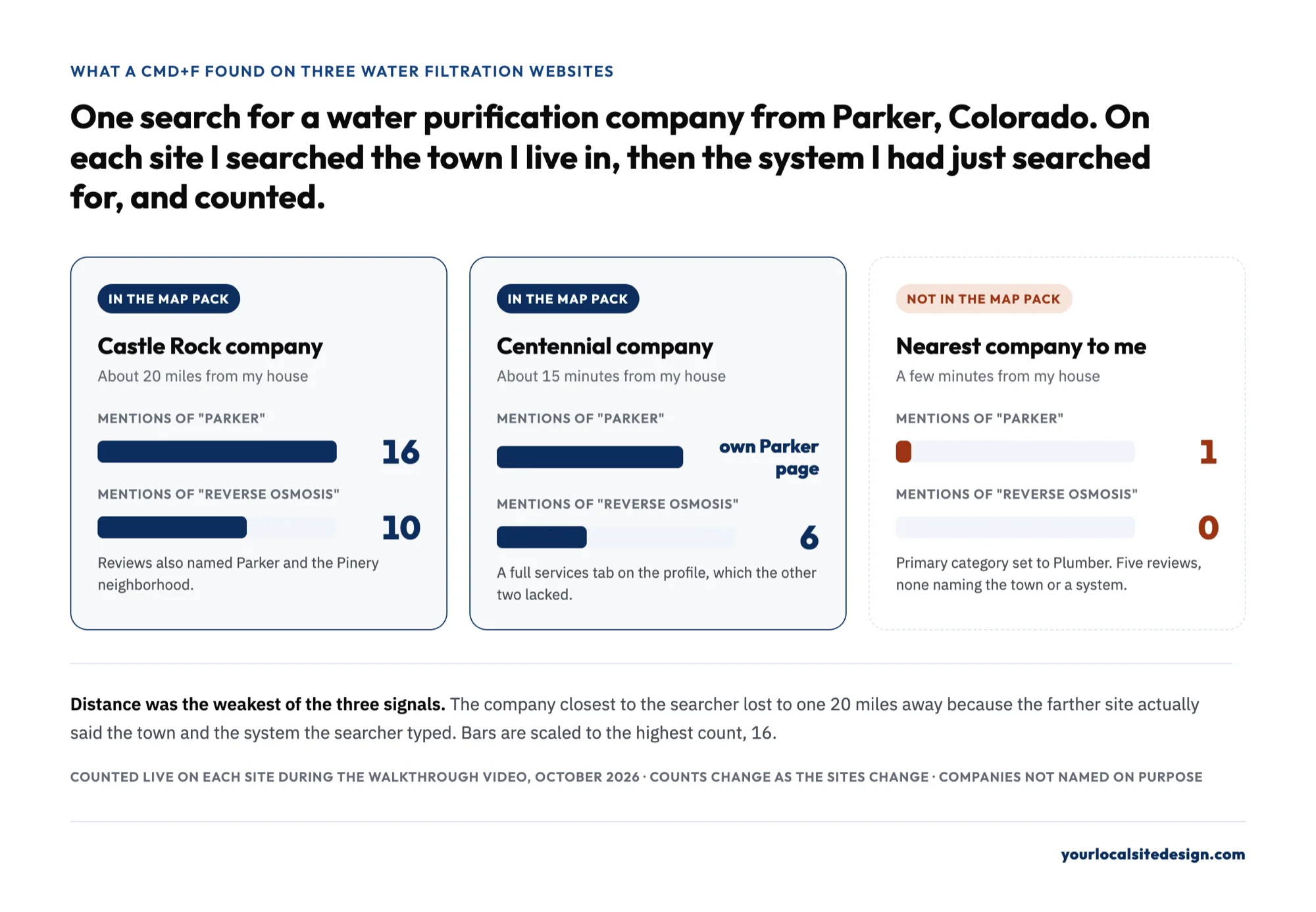
The Centennial company, 15 minutes away and showing in Parker, had a whole page devoted to Parker. It mentioned reverse osmosis six times with real information under each mention. The Castle Rock company mentioned Parker 16 times and reverse osmosis 10 times. The company nearest to me mentioned Parker once. Reverse osmosis, which I had just searched for, did not appear on its site at all.
That is the gap. Not a secret algorithm, a website that never says the words the customer typed. It is also why every filtration site we build gets one page per system: whole-house, under-sink and reverse osmosis, well water, PFAS, filter replacement. Someone searching for a filter change and someone researching a whole-house system are two different customers, and one page cannot rank for both.
Step Five: The Ones Google Left Out
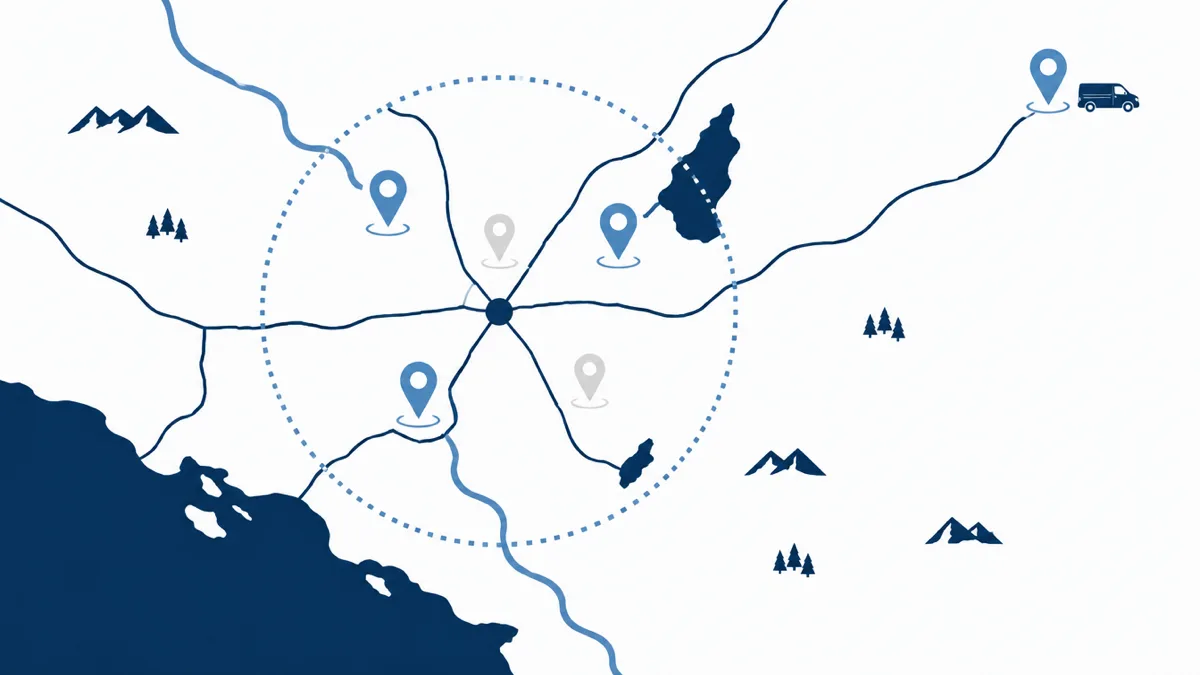
Looking at who did not show taught me as much as who did.
The company nearest my house. Primary category Plumber. Five reviews, none mentioning the town or any filtration system. A site that mentioned Parker once and reverse osmosis never. Google had three reasons to leave it out and no reason to include it.
A distributor. When I widened the map, a company a long way south appeared. Its site read like an ecommerce catalog with installation as a side note. Google has every click, every call button press and every visit to that site, and my read is that it uses them. A page that homeowners bounce off does not get served to homeowners.
The company with no address. One profile in the pack hid its address and sat far outside Parker, yet it ranked, and its reviews mentioned reverse osmosis more than anyone else's. Hiding your address usually hurts a service area business. This one had enough review relevance to outweigh it. That is the exception, not the plan.
The name. The top profile had "water purification company" in its business name. If that is genuinely your registered name, use it. Do not stuff keywords into a name that is not yours. It is a documented violation and the suspension costs you more than the words ever earned.
What Google Is Actually Weighing
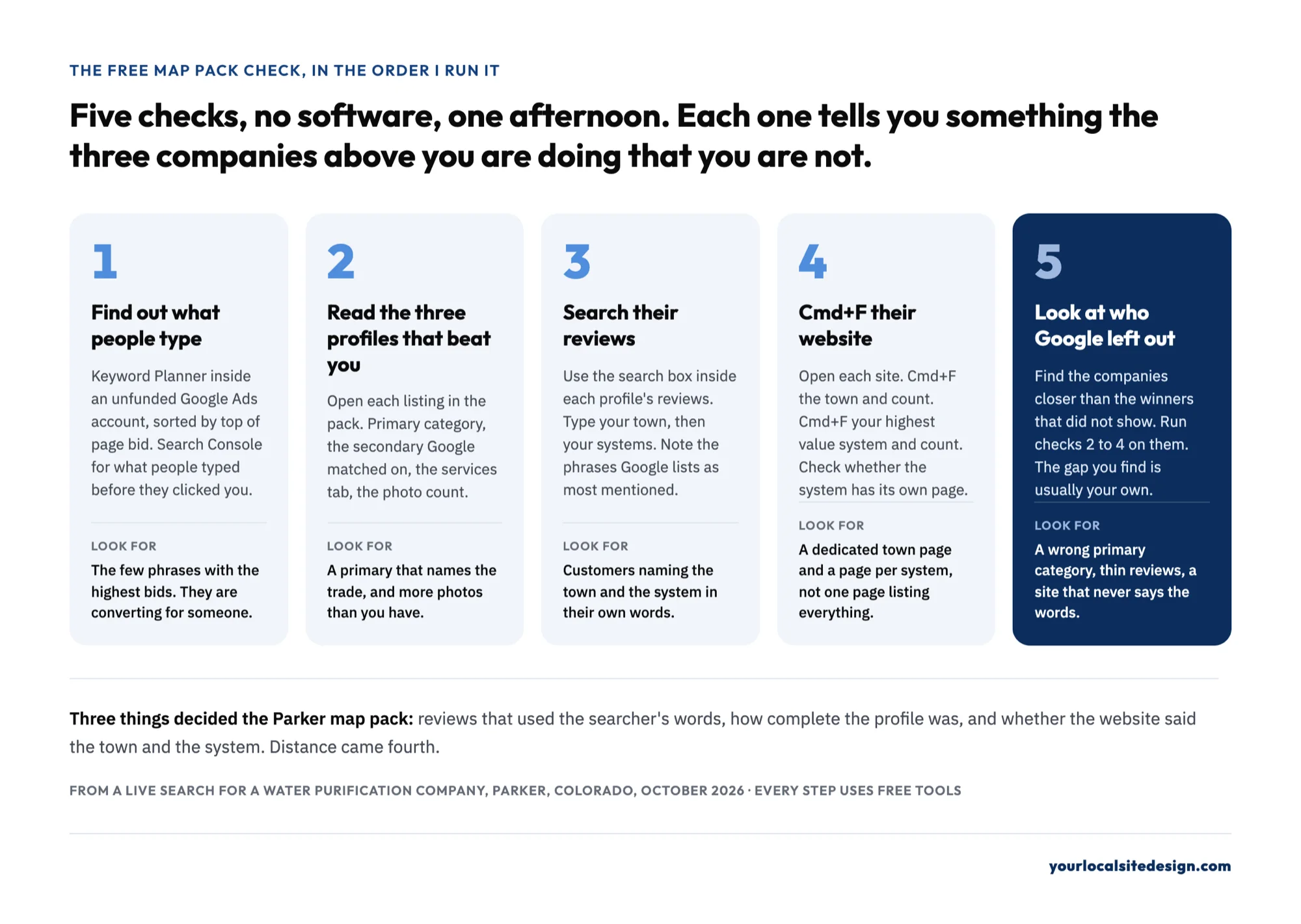
Strip the walkthrough down and three things decided the Parker map pack.
- Reviews, how many, how recent, and whether real customers used the words a searcher uses.
- How complete the profile is, starting with the primary category and running through services and photos.
- The website, whether it says the town and the systems, and whether it says them on pages a homeowner can actually use.
Distance was weaker than people assume. A Castle Rock company beat a Parker company for a Parker search because it won the other three.
None of this is a guarantee that one fix moves you to the top. It is a way to see your gap without paying anyone. The free checks take an afternoon. Keeping them up, asking for the review after every job, adding the photos, building the page, is the part most owners stop doing, and that is the part the local SEO plan exists for.
Where the Free Version Stops
I pay for software that shows the exact reasons a profile ranks where it does, and I run it as a report. The free version above gets you most of the way: it tells you where your gap is and what to do about it.
If you would rather have the report, the free competitor teardown covers it. I pull your profile against the three companies above you, show you what their sites have that yours does not, and send it in 48 hours. And if you are a water filtration company that wants the site built with a page for every system you sell, the water filtration page has the price posted, which is more than I could say for most of the profiles I looked at.