
There are perhaps twenty things that affect where a Castle Rock business shows up in local search. Four of them account for most of the outcome, and they pay in a specific order.
This is that order, and it is deliberately boring. The interesting work is rarely the work that moves anything.
First: the primary category, which is free
One dropdown in your Google Business Profile decides which searches you are eligible to appear in at all. Not how well you rank in them. Whether you are in the running.
A roofer listed as Contractor is competing in a different pool from a roofer listed as Roofing Contractor, and the searches that pay are in the second pool. Get this wrong and everything downstream is wasted, because you are optimising for a race you are not entered in.
Two things make this the first lever rather than the fourth. It costs nothing, and it can move you within weeks rather than months.
It is also the item most often left exactly as it was set on the day the profile was created, sometimes years ago by somebody who no longer works there.
Second: proximity, which nobody can change
This is the part most agencies will not tell you plainly, so here it is.
The map pack weighs how close your business sits to the person doing the searching. Somebody standing in the middle of Castle Rock and somebody standing in Franktown see two different sets of three businesses, and neither list knows the other exists.
You cannot optimise past your own address. No budget changes it.
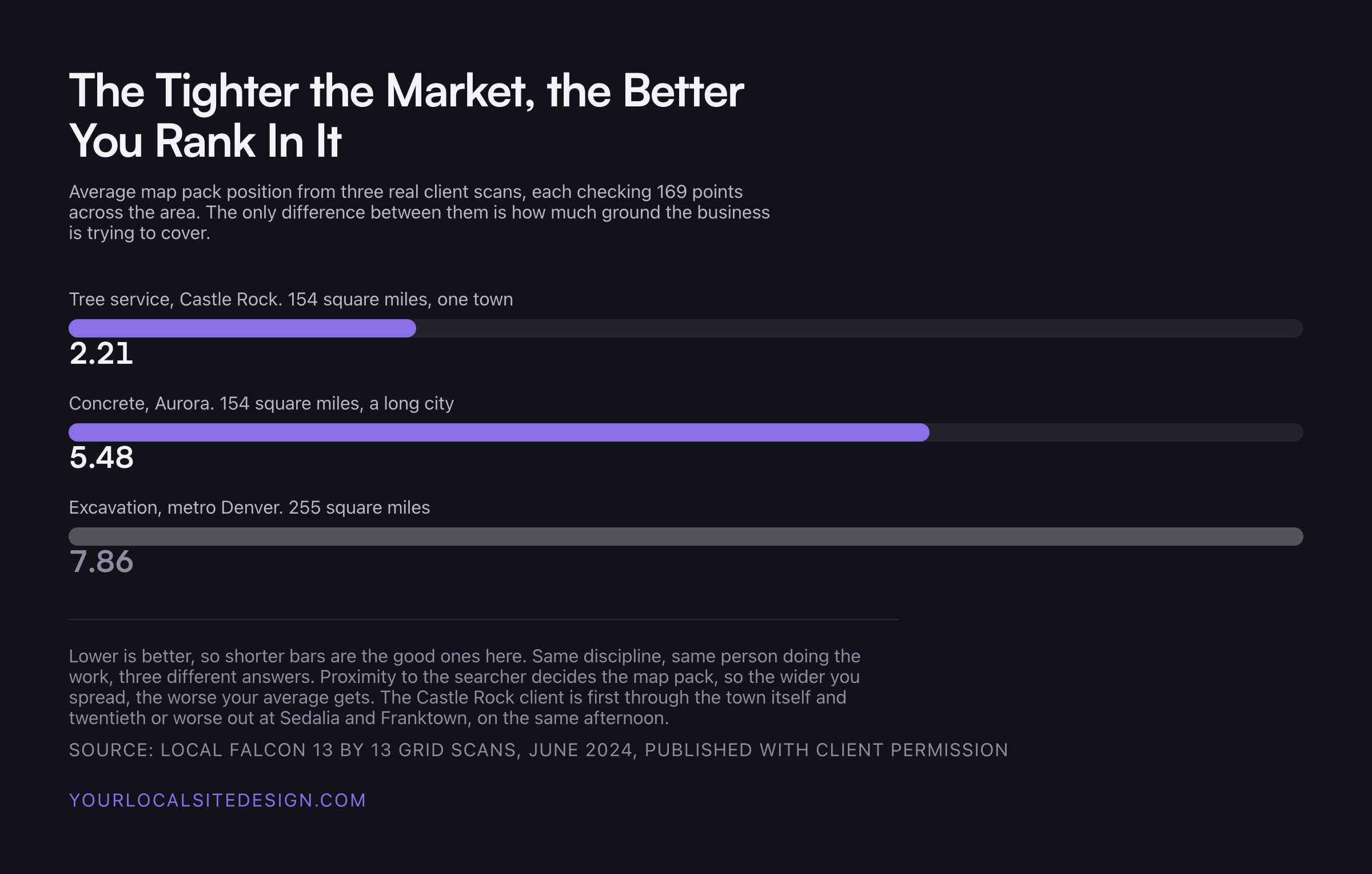
Those are real scans of three clients, each checking the ranking from 169 separate points across their area. The Castle Rock one is first through the town itself and twentieth or worse out at Sedalia and Franktown, on the same afternoon, with the same website and the same reviews.
The only thing that changed between those two readings is where the person searching was standing.
Which means the honest goal is not to rank in Castle Rock. It is to rank across the part of it you can actually reach, and to use organic pages rather than the map pack for the rest.
Anybody promising you the whole metro is describing something that does not exist. In a town this size that mostly works in your favour, because the winnable radius covers nearly the whole town.
Third: the pages, which is where the work is
This is the part people want to skip, and it decides the outcome.
A page for every service you sell. Not one page called Services listing nine things, which can rank for one of them at most. Somebody searching for a specific job will not dig through a combined page to find it, and neither will Google.
Then a page for every town you genuinely drive to. Real pages about work you have done there. Not one page duplicated with the town name swapped, which has a name at Google and works against you rather than for you.
For most Castle Rock service businesses that is somewhere between eight and thirty pages. It is unglamorous, it is writing rather than technology, and it is the half that compounds. It is also the half that stops working the month you stop doing it.
That page-by-page work is the build itself, and web design in Castle Rock sets out what it covers and what it costs.
Fourth: reviews, which do two jobs
Reviews are the only ranking signal that also closes the sale for you. Everything else on this list gets you seen. Reviews get you seen and chosen.
Volume matters, recency matters, and responding matters, because Google reads responses as activity. In a market the size of Castle Rock the gap between a business with fifteen reviews and one with a hundred and fifty is frequently the whole difference in the pack.
The mechanism that works is a repeatable ask at the moment the customer is happiest, sent from the truck rather than a link at the bottom of an invoice nobody opens. It is part of what the monthly work involves. Ask them to name the job and the town, because that is the wording Google and the AI assistants read back.
What This Looks Like Over Six Months
Roughly, and with the usual warning that nobody controls Google:
- Month one to two. The profile work lands. Lower competition terms start shifting. Real movement, not yet worth much on its own.
- Month three to five. Pages index and start ranking. The map changes in your closest streets first, because proximity decides that order.
- Month six. Call volume you can feel. This is the month worth measuring against, and the one I would rather set expectations on now than argue about later.
- Month twelve. Full return, if the pages kept coming.
The Order Is the Point
If you take one thing from this: category, then proximity, then pages, then reviews.
Most agency proposals invert it. They lead with the technical audit, because an audit is a deliverable that can be produced in an afternoon and looks substantial. Then months of reporting on a site that structurally cannot rank, because nobody built the pages.
If you are hiring this out rather than doing it, the five questions that sort providers fast will tell you quickly whether they work in this order or the other one.
The category takes ten minutes. The pages take months. Doing them in the other order is how a year goes by with green arrows on a report and a phone that has not changed.
If you want to know which of the four is your bottleneck before spending anything, the diagnostic is here, and it takes an afternoon.