

Every contractor who has bought leads has had the same three thoughts in the same order. The first is that the phone rang the day you signed up, which nothing else you've ever tried did. The second comes a few weeks later, when a lead you paid for says they already hired someone, and the credit request comes back denied. The third is the one this guide is about: what, exactly, am I paying for, and would the same money do more somewhere I own?
The comparisons that rank for this question are written by companies selling a third thing, and they quote Angi and Thumbtack prices that neither platform has ever published. So this one does something different. It reads what Angi and Thumbtack say about their own marketplaces, in their help centers and terms of use. It reads the annual report Angi files with the SEC. It reads what the Federal Trade Commission alleged in 2023. Then it puts all of that next to what a contractor website costs and what a free Google listing does, so you can decide with the platforms' own words instead of a vendor's guess.
How a Shared Lead Actually Works, in the Platforms' Words

Angi. The help center for Angi for Pros says: "Each time a homeowner submits a project request, we will match them with no more than five pros." You pay "when both you and the homeowner show interest in connecting with each other." Lead fees "change based on task, homeowner location, and demand for the work," and no dollar amount is published anywhere on Angi's pages. You set a monthly budget; if you're on a subscription, "your monthly budget is set annually per your contract." Since late January 2025 Angi has run what it calls homeowner choice, where a pro only gets a lead when the homeowner picks that pro from a list, replacing the automatic matching that Angi's own shareholder letter described as "lower-quality." Angi reported its pros' self-reported win rate rose 10% after the change.
Thumbtack. "There's no charge to join, no annual fees and no membership fees." You set your own lead prices, and the help center is clear about when they bite: "When a customer reaches out to you directly from search results" and the job fits your preferences, "you auto-pay for the lead." The charge lands when the customer contacts you, not when they reply to you or hire you. The second type, Opportunities, where you reach out first, bills only "if the customer responds to you." Budgets are weekly and reset on Monday. Thumbtack publishes no cap on how many pros one customer can contact. Its own refund policy, though, is written for a world where they contact several: the automatic Fair Shot refund applies only "if a customer doesn't reply to any pro they contacted within 72 hours."
That last clause is the whole shared-lead business in one sentence. The platforms are not hiding it. One homeowner, one form, several contractors each paying for the same name. On Angi the ceiling is five. On Thumbtack a moderator on the company's community forum described the limit as four pros in the first four hours, hedging on the time frame, and a pro in the same thread described a $112 lead where "the customer contacted FIVE pros." Those two are forum posts, not policy, and they're the only numbers you'll get, because the policy doesn't state one.
The Rules You Agree To

The second thought every lead buyer has, the denied credit, is also written down.
HomeAdvisor's lead-credit guidelines, still live under Angi, list the situations that do not qualify for a credit: "Consumer is not calling you back." "Consumer already found someone to complete the work." "Consumer changed their mind." "Consumer is just 'shopping'." "You did not win the job." The page explains why in one line: these are "accounted for in our lead pricing and therefore not eligible for lead credits." Requests must be made within 30 days, and credits you do get expire six months after they're issued. Cancelling an Angi agreement, per Angi's September 2026 help article, is done by phone, Monday to Friday, 8 AM to 8 PM Eastern. The article mentions no notice period, no fee, and nothing about what happens to your profile or reviews, so ask before you sign.
Thumbtack's refund policy opens with its Terms of Use: "all sales and fees on Thumbtack are final and non-refundable." Case-by-case refunds can be requested within 45 days. Losing the job to another pro is listed under situations where "we don't provide refunds." The Fair Shot refund is automatic but has four conditions: your first contact went through Thumbtack, the customer didn't reply to you or any other pro within 72 hours, you answered within four business hours of the request, and you didn't share your own phone number or email before the customer's first reply.
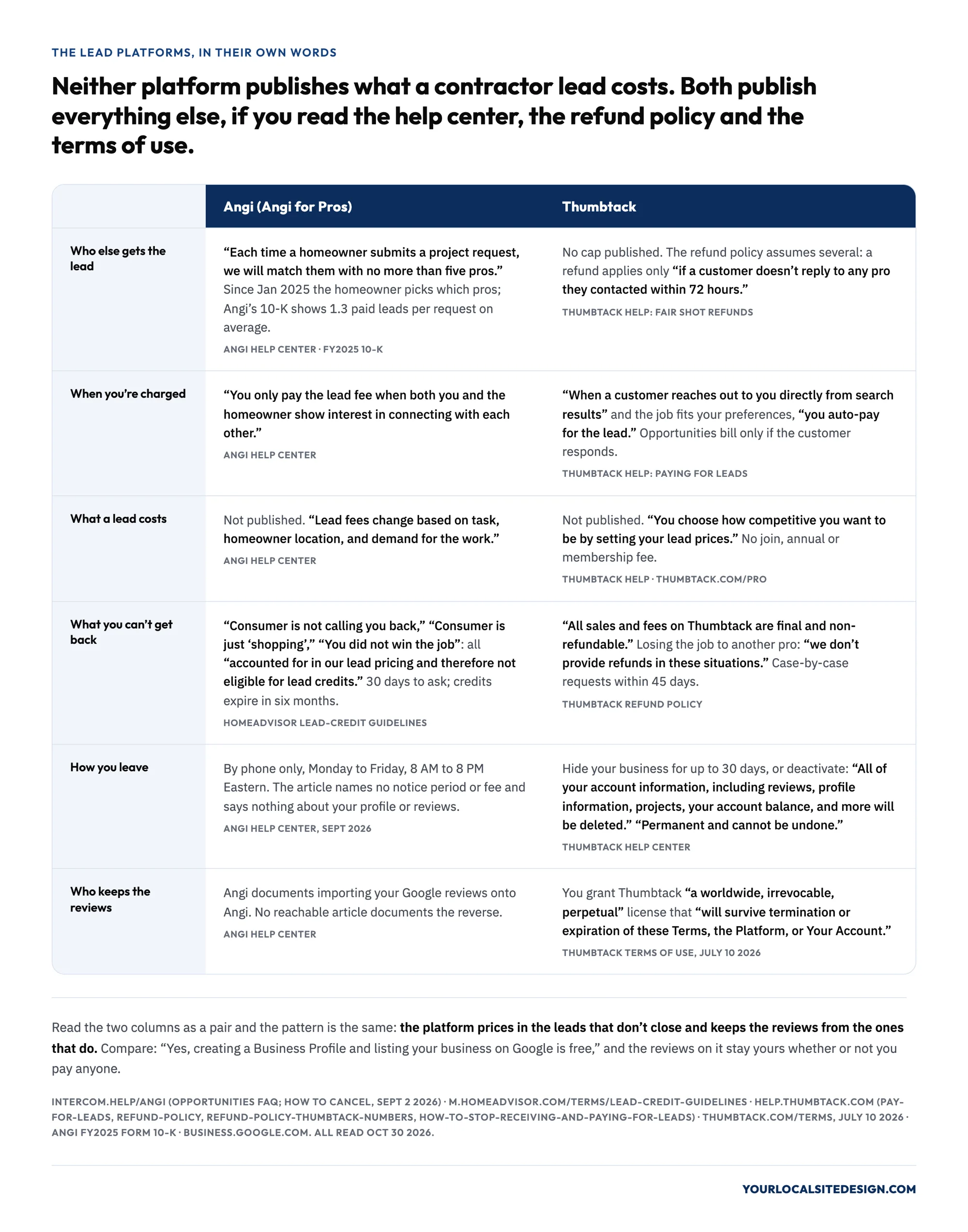
None of this is a scandal. It is a marketplace pricing the fact that most leads don't close and spreading that cost across every pro who pays for them. The point of reading it is that the contractor is the only party in the arrangement who hasn't priced it in. Angi recommends homeowners "get at least three quotes." The roofing survey covered below found two-thirds of homeowners plan to gather three quotes and another quarter plan on more. The platforms built the race on purpose, because the homeowner asked for it. You are paying an entry fee per heat.
What Angi's Own Filing Says
Angi is a public company, so once a year it has to describe its marketplace in numbers rather than marketing. The annual report for 2025, filed with the SEC in February 2026, is more candid than any review site.
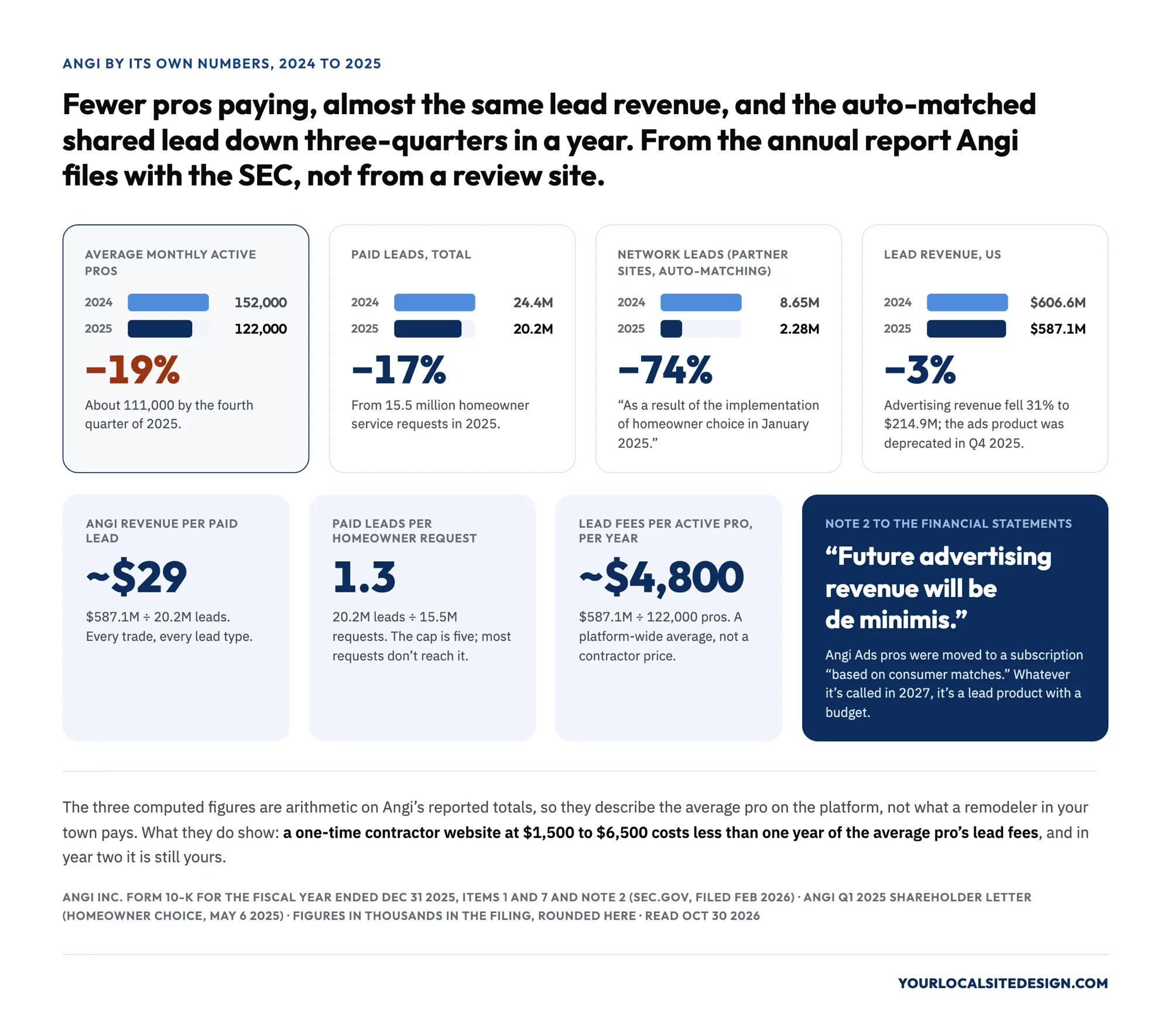
Three things in that table matter to a contractor deciding where to put money.
Fewer pros are paying, and each is paying more. Average monthly active pros fell from 152,000 in 2024 to 122,000 in 2025, a 19% drop, and to about 111,000 by the fourth quarter. Lead revenue barely moved, down 3% to $587 million. Divide one by the other and the average active pro sent Angi about $4,800 in lead fees over the year. That's a platform-wide average across every trade and every size of business, so a one-crew remodeler may pay far less and a multi-truck operation far more, but it's the only figure that comes from Angi rather than from a blog.
The auto-matched shared lead is shrinking, on Angi. Network leads, the ones that came through partner sites and automatic matching, fell 74% in a year, and Angi says plainly that this was "a result of the implementation of homeowner choice in January 2025." Across the whole business, 20.2 million paid leads came from 15.5 million homeowner requests, about 1.3 paid leads per request. So the five-pro cap is real, but on today's Angi most requests aren't reaching it. If your Angi experience dates from 2023, the product has changed under you, in the pro's favor. Thumbtack publishes no equivalent figure, so the same can't be said there one way or the other.
Angi Ads is gone. In the fourth quarter of 2025 Angi "deprecated the advertising offering" and moved those pros to a subscription "based on consumer matches." Its own words: "Future advertising revenue will be de minimis." If you're being sold an Angi product in 2027, it's a lead or match product with a budget attached, whatever the sales rep calls it.
Then there is the regulator. In January 2023 the Federal Trade Commission announced an order requiring HomeAdvisor, doing business as Angi Leads, to pay up to $7.2 million in redress to service providers. The FTC alleged that since at least mid-2014 the company had made "false, misleading, or unsubstantiated claims about the quality and source of the leads," that it told pros they would only receive leads matching their services and area when "many of them do not," and that it "often tells service providers that its leads result in jobs at rates much higher than it can substantiate." The final order, dated April 21, 2023, bars claims that leads come from people ready to hire, or who submitted a request directly to HomeAdvisor, when that isn't true, and bars unsubstantiated claims about how often leads turn into jobs. It was a settlement, not a fine, and the company did not admit wrongdoing. It is also the reason you should treat any conversion rate a lead salesperson quotes you as a claim the FTC has already looked at once.
Who Owns the Reviews
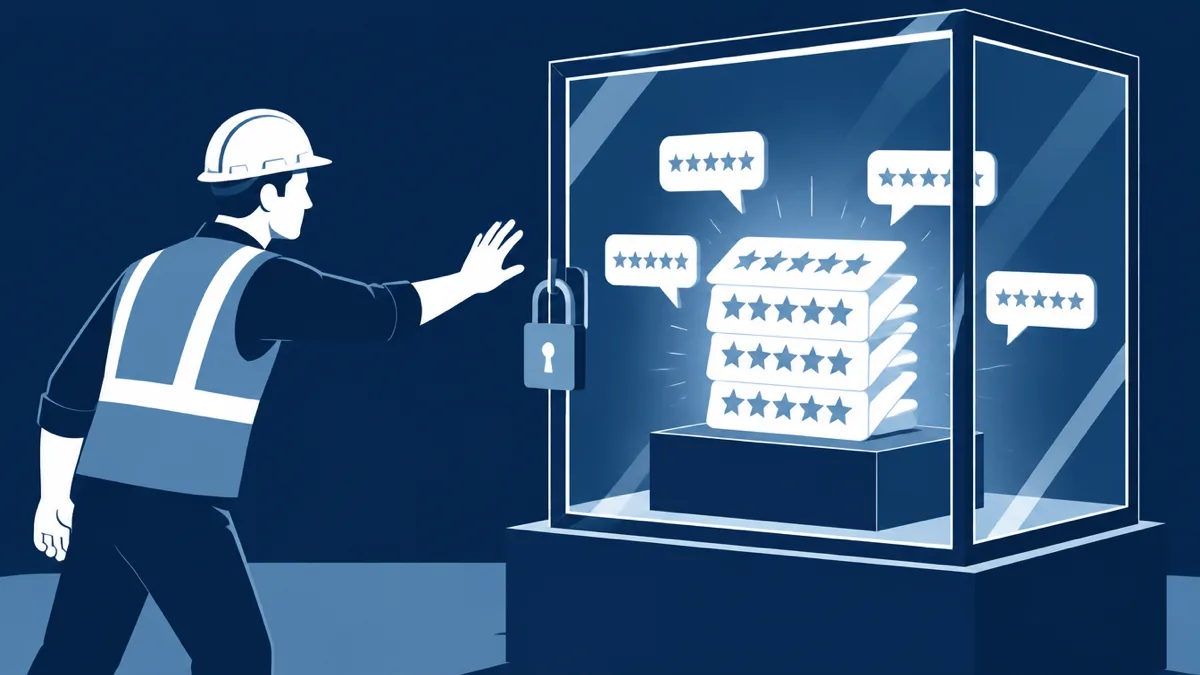
This is the cost nobody puts on the invoice. Every job you win through a platform ends with a review, and the review is the most valuable thing the job produced after the check. Where it lands decides who owns the relationship with the next homeowner.
Thumbtack's Terms of Use, last updated July 10, 2026, has you grant the company "a worldwide, irrevocable, perpetual" license to the content on your profile, reviews included. "The license granted to Thumbtack will survive termination or expiration of these Terms, the Platform, or Your Account." And: "If Your Account is canceled, we do not have an obligation to delete or return any Content You have posted to the Platform." The help center is blunter about what deactivation does on your side: "All of your account information, including reviews, profile information, projects, your account balance, and more will be deleted. This action is permanent and cannot be undone."
Angi's help center documents a way to bring Google reviews onto your Angi profile. No reachable Angi article documents the reverse, and the cancellation article says nothing about what happens to your profile or reviews when you leave. Older HomeAdvisor pro agreements had the pro grant the company a perpetual license to anything they submitted; the current pro terms weren't reachable at a public URL when this was written, so read yours.
Put that against the alternative. Google's own page says: "Yes, creating a Business Profile and listing your business on Google is free." BrightLocal's 2026 Local Consumer Review Survey, 1,002 US adults, found 97% of consumers read reviews for local businesses and 71% use Google to read them, down from 83% a year earlier as AI tools climbed from 6% to 45%. A review on your Google profile sits on the listing most of your market reads, next to your own phone number, with no competitor's name on the same screen. It stays there when you stop paying Angi, stop paying Thumbtack, or fire your web designer. Five years of platform reviews are five years of reputation that was never yours to take.
Where Homeowners Actually Start

The platforms sell access to homeowners who are already looking. It's worth asking how many homeowners look there. There's no national survey of how homeowners find a general contractor, but Roofing Contractor magazine's homeowner survey, run with Owens Corning as research partner and completed in October 2025, asked roofing customers exactly that, and roofing is as close to remodeling as a published survey gets.
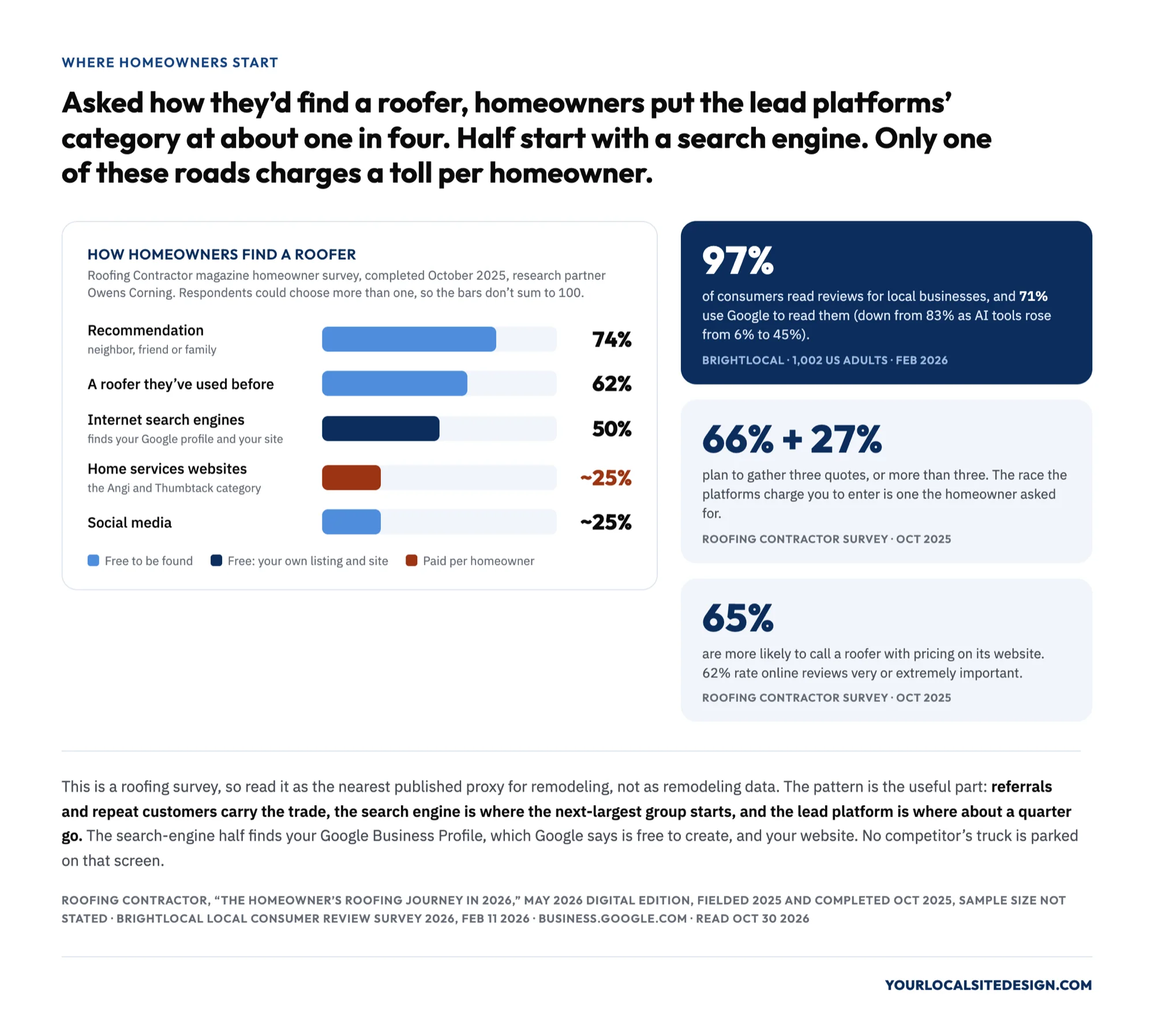
Half of those homeowners use a search engine. About a quarter use a home-services website, the category Angi and Thumbtack live in. Three-quarters ask a neighbor, and 62% go back to someone they've used. Roughly 62% rate online reviews very or extremely important, and 65% say they're more likely to call a roofer with pricing on its website. Read those together and the shape of the market is clear: the referral and the repeat customer still carry the trade, the search engine is where the next-largest group starts, and the lead platform is where a quarter of them go. The platform is a real channel. It is not the main road, and it's the only one of the five where you pay a toll per homeowner.
What the search-engine half finds is your Google Business Profile and your website. Nobody else's truck is parked on that screen.
What the Same Money Buys
Here is the comparison the vendor blogs skip, because it uses a real price on both sides.
Angi's filing puts the average active pro's lead fees at about $4,800 for 2025. A contractor website built the way the trade page describes, a page per job type, a page per town, license and reviews on the first screen, a tappable phone number everywhere, runs $1,500 to $6,500 one time, with most contractors landing near $3,500. The domain, the hosting, the Google Business Profile and the tracking number are registered in your name on launch day. Ongoing search work is optional and month to month.
So for most contractors, one year of average Angi lead fees costs more than the site. The difference is what you hold in year two. The platform spend bought twelve months of entries into a race against up to four other trucks, and the reviews stayed behind. The site is still there, ranking a little higher than it did, with the reviews on a Google listing that is free to keep.
The proof is the same kind shown on every page of this site: call counts pulled straight from a client's own Google Business Profile, 22 to 36 calls in a month for an electrician in Highlands Ranch, 26 to 41 for a tree service in Castle Rock. Those are calls to a number the client owns, from homeowners who searched, found one business and dialed it. No one else was charged for the same ring.
Whether a site or a platform is the better buy for you comes down to the cost-per-booked-job math from the last post in this series: cost per booked job from any channel should stay under 15% of your average ticket. On a $28,458 minor kitchen that's $4,269 a job. On an $18,263 wood deck it's $2,739. A platform lead that takes eight tries to book a kitchen can clear that line. The same lead on decks, in a five-way race, usually can't. Your own site has no per-lead price at all, so once it's ranking, every additional call pushes the number down instead of up.
The Honest Case for the Platforms
A comparison that only lists the platforms' weaknesses is as useless as the ones that quote invented prices. There are three situations where Angi or Thumbtack is the right call.
You're new, or you've moved. A website takes months to rank and a Google profile takes reviews to matter. A platform rings on day one. If you have a crew to feed and no pipeline, the entry fee is worth paying while the owned channels build.
Your tickets are small and your close is fast. Thumbtack's model, where you set the lead price and leads bill individually until you've spent $1,000, suits a handyman or a small repair outfit that can quote from a photo and book the same day. The race hurts less when the race is short.
You have slow weeks and a tight budget cap. Both platforms let you pause. Angi pauses leads for up to two weeks, Thumbtack hides your business for up to thirty days. Used as a valve you open when the calendar is thin and shut when it's full, a platform is a reasonable tool. Used as the only source of work, it's a landlord.
The mistake isn't using them. The mistake is paying them for five years and ending up with nothing you own.
How to Decide This Week

- Pull twelve months of platform statements. Total paid, by platform. That's your real annual lead cost, not the per-lead number.
- Count the jobs those leads booked. Not the leads, not the estimates. Signed jobs. Divide the spend by that count for cost per booked job, and compare it to 15% of your average ticket. Under it, the channel earns its keep. Over it two months running, it doesn't.
- Count the reviews you earned there. Then check how many of those customers also reviewed you on Google. Every one who didn't is reputation you're renting.
- Check your Google Business Profile. Is it in your name, with your phone number, your categories, your service area and current photos? It's free. If a platform profile is more complete than your Google one, you've been maintaining the landlord's building instead of your own.
- Read the clause before you cancel. Angi's cancellation is by phone, and your contract decides the terms. Thumbtack's deactivation deletes the reviews. Screenshot everything first.
- Decide what the platform is for. A valve for slow weeks, or the whole pipeline. If it's the whole pipeline, that's the thing to change, and the site is how.
If you'd rather have someone pull this apart for you, the $47 teardown looks at your site, your Google listing and the three contractors outranking you, and tells you where the leak is, in 48 hours. The build itself is on the contractor website design page, and if you want to see who else builds for general contractors and what each one charges, the comparison of ten web design companies is the place to start.