
Is SEO still worth it in 2026? Yes. The more useful question is worth it compared to what, because the generic answer online, usually some version of an 8x return, is not the number that applies to a home service business, and it is not the number that accounts for how much search itself changed this year.
So here is the real version: what SEO actually returns for a trade business specifically, a real client's rank history rather than an industry average, how long it actually takes, and the three honest questions that decide whether it is worth it for you rather than for a case study.
"SEO Is Dead" Has Been Said Every Year Since 2001
Google's own Gary Illyes put it plainly: SEO has been dying since 2001, the same year the term was coined. That is not a defense of doing nothing. It is useful context for how much weight to put on this year's version of the same claim, because there have been several before it, each one tied to something real that changed, and none of them actually ended the thing they predicted would end.
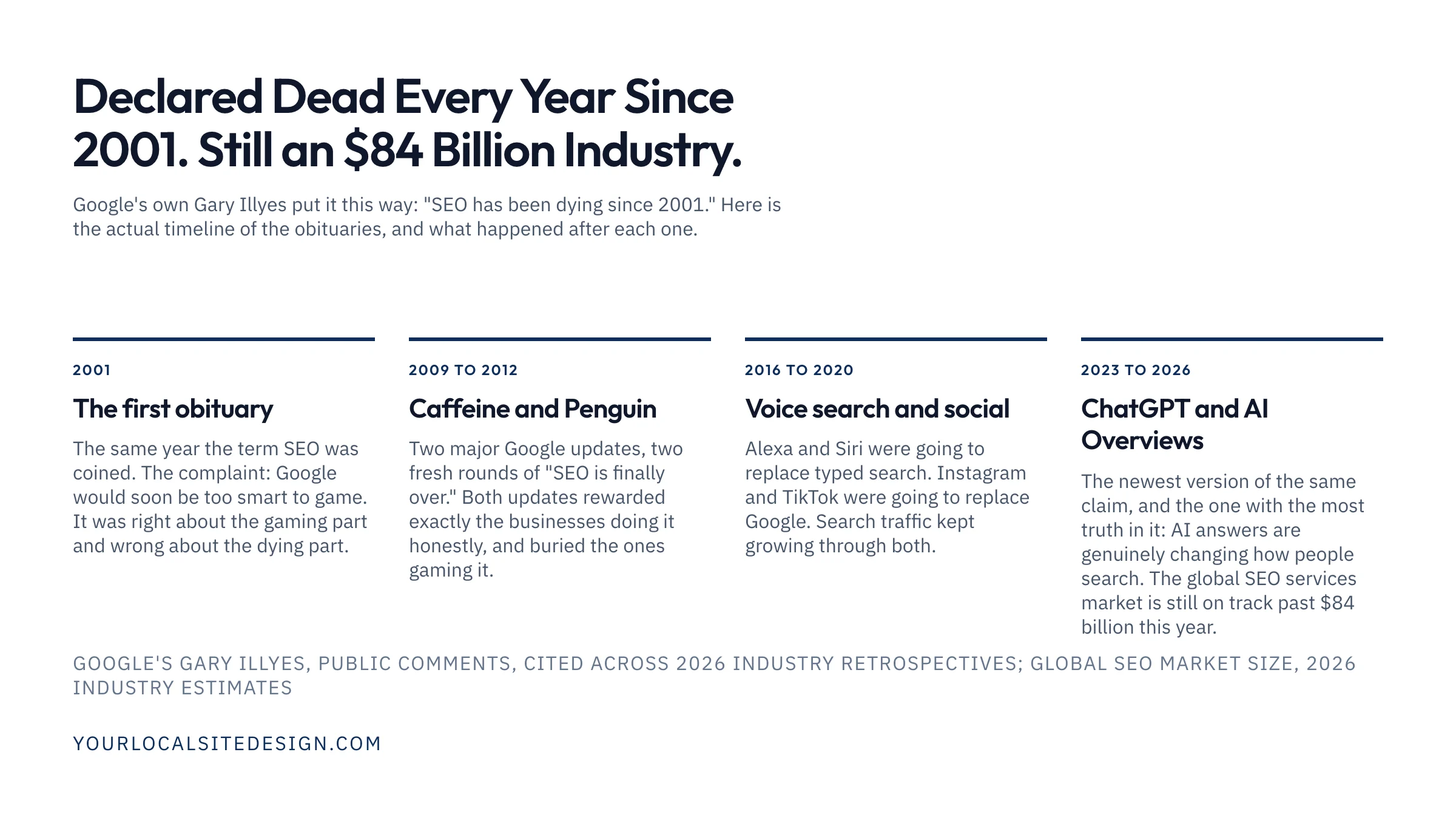
The 2023 to 2026 version has more truth in it than the earlier ones. AI Overviews and chat assistants are genuinely changing how people search, which the AI SEO page for Denver goes into in detail: about 68 percent of Google searches in 2026 end without a click, up from roughly 45 percent a decade ago, and the top organic result sees close to a 58 percent lower click-through rate when an AI Overview appears above it. That part is real and worth planning around. It is not the same thing as SEO stopping working, and the data on what SEO actually returns backs that up directly.
What SEO Actually Returns for a Home Service Business
Most "is SEO worth it" articles quote one number: roughly 8x return, averaged across every industry that buys SEO, from ecommerce to SaaS to local trades. That number is real, and it understates what this specific kind of business sees.
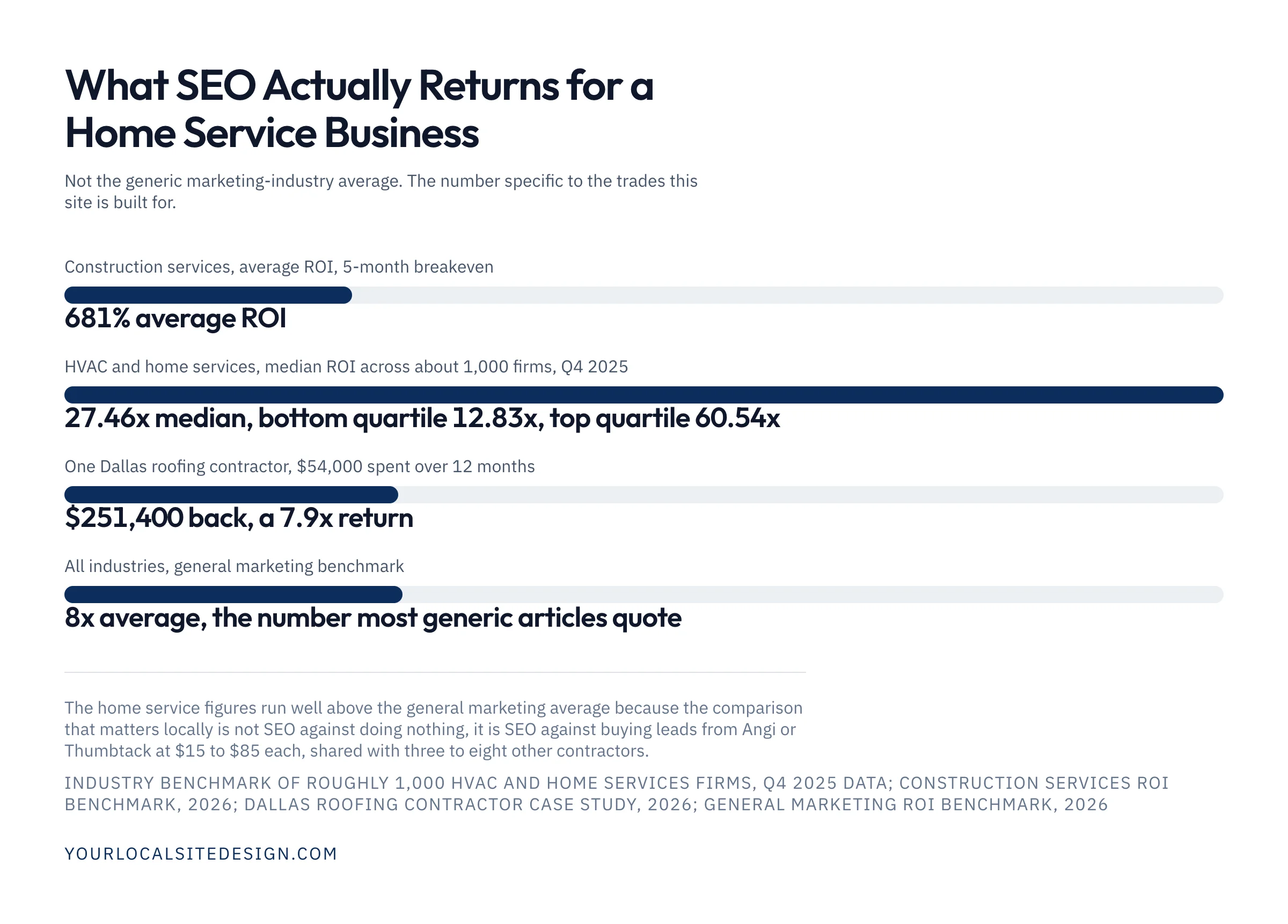
A 2026 benchmark covering roughly 1,000 HVAC and home service companies found a median return of 27.46x, with the bottom quarter of businesses still seeing 12.83x and the top quarter seeing 60.54x. Construction services specifically average a 681 percent return with a five-month breakeven. One Dallas roofing contractor's numbers, cited in a 2026 case study, are a useful sanity check on what that looks like in dollars: $54,000 spent over twelve months, $251,400 in directly attributed revenue back, a 7.9x return.
The reason the home service number runs so far above the general marketing average is the comparison that actually matters locally. It is not SEO against doing nothing. It is SEO against buying leads from Angi or Thumbtack at $15 to $85 each, shared with three to eight other contractors, every single month, forever. A page that ranks stops charging per lead the moment it starts working. That math, line by line, is on the small business web design page, and what the monthly search work itself costs here is on local SEO.
A Real Rank History, Not a Case Study
Industry benchmarks are useful for scale. They are not proof for your specific town. Here is a client's real rank-tracker export, screenshots, not a summary.
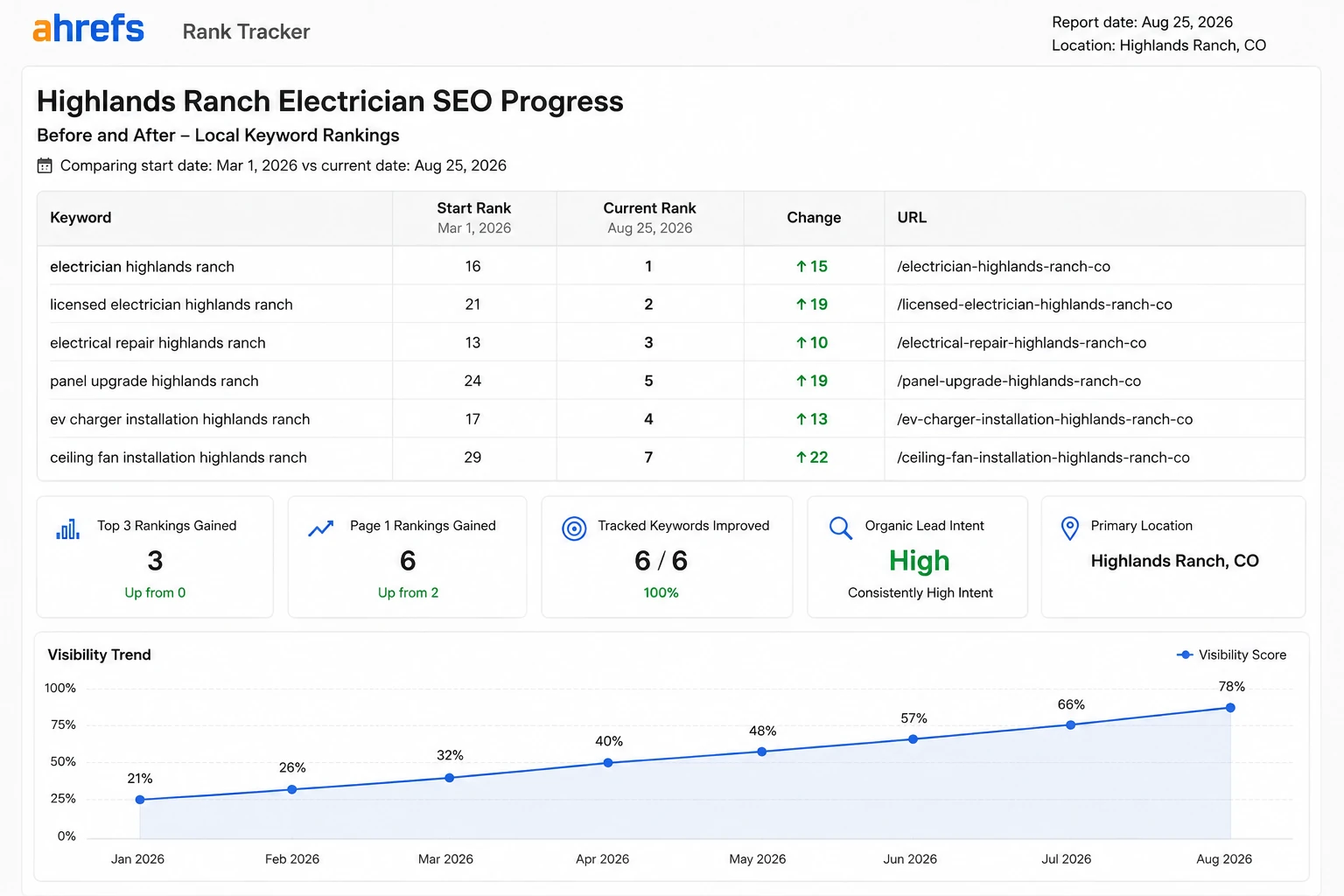
Parks Electric, Highlands Ranch, fifteen minutes from Parker. Sixteenth to first for his main search, five more keywords moved with it, visibility up from 21 to 78 percent across six months. The full build behind it is on web design in Parker.
That is one business. The pattern holds elsewhere. A Centennial gym's own Google Business Profile shows the same shape from a different angle: not a ranking number, a call count.
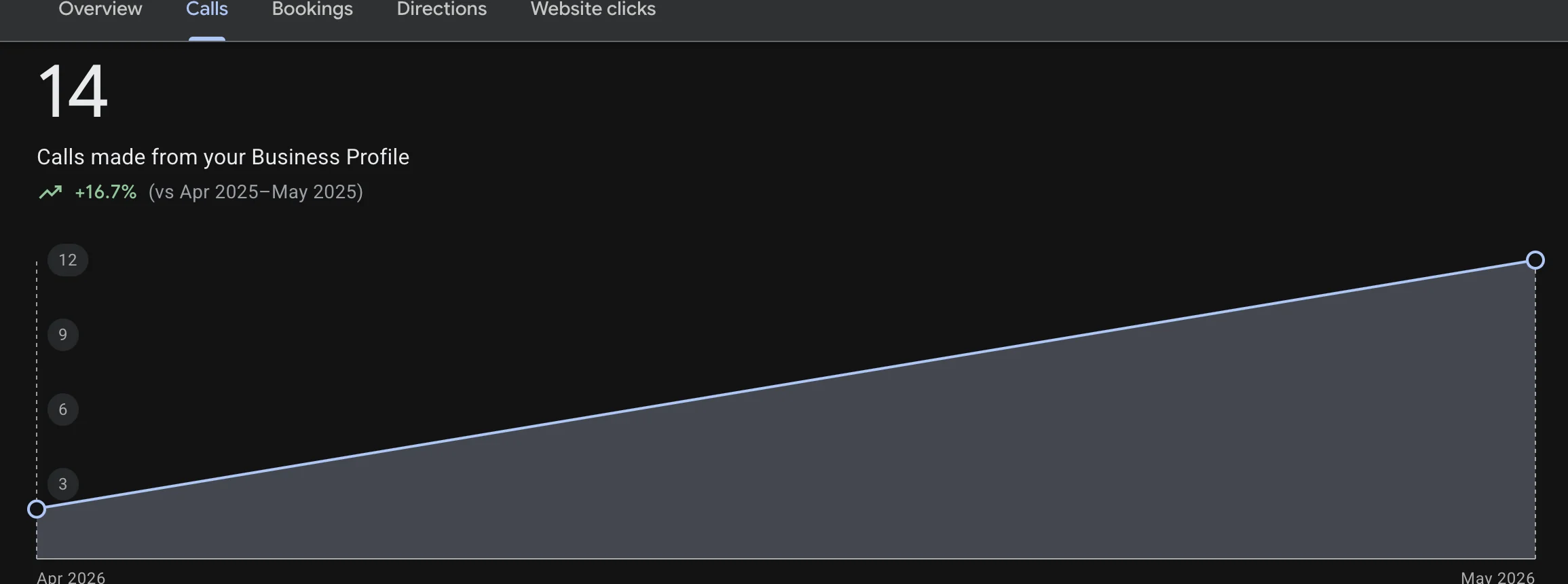
Calls from about 2 a month to 12, after one month of listing work alone, before any new pages were built. That is the part a ranking report does not show on its own: what a rank actually turns into on a phone. Both screens, plus a Castle Rock tree service at 41 calls a month, are shown in full on SEO in Castle Rock.
The Honest Timeline, Not the Sales Version
Every SEO pitch leads with the big number at the end. Almost none of them lead with month one, which is where the real, honest timeline actually starts, and where most people give up.
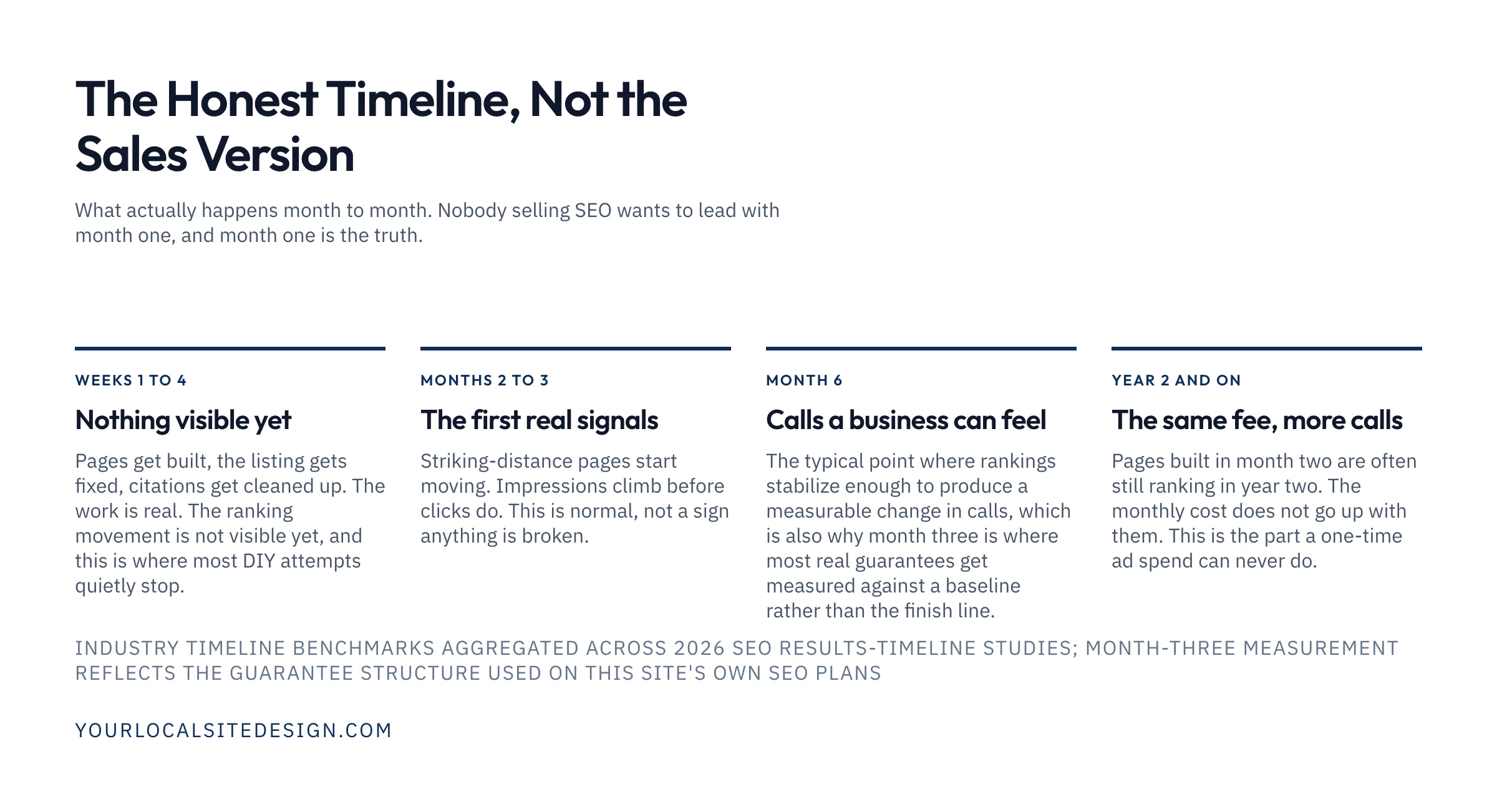
The first month produces real work and almost no visible movement: pages get built, the Google Business Profile gets corrected, old citations get cleaned up. That stretch is exactly where doing it yourself most often stalls, because nothing on the surface has changed yet even though the foundation has. Months two and three bring the first measurable signals, usually impressions before clicks. Month six is the typical point where a business can feel a real change in call volume, which is also why a results guarantee gets measured against a baseline at month three rather than at the finish line. After that, the math changes in a way a one-time ad spend cannot match: a page built in month two is often still ranking in year two, at the same monthly fee.
Worth It Depends on Three Things, Not One
The honest answer was never a flat yes or no. It is these three questions, answered for your own business rather than for an average.
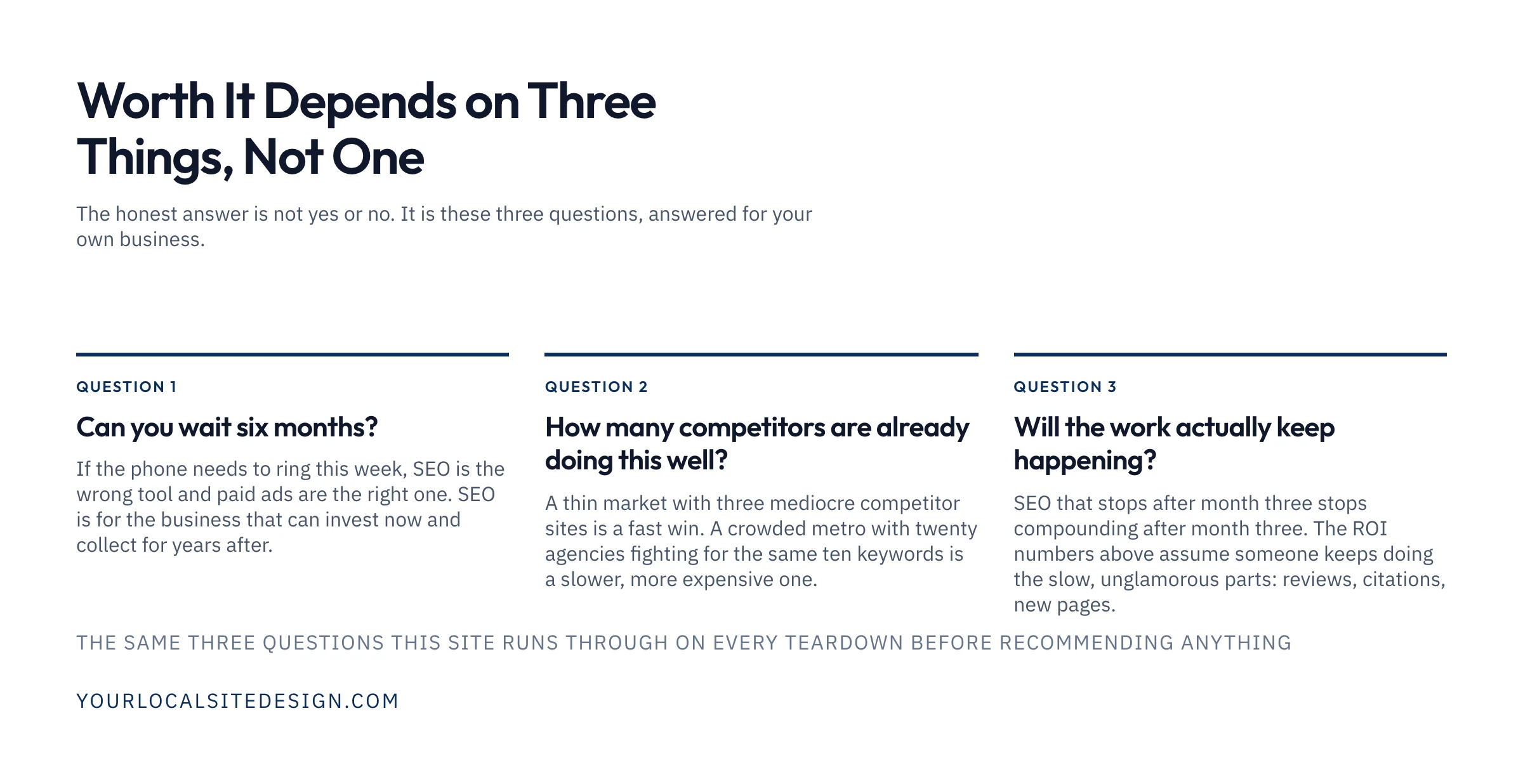
If the phone needs to ring this week, SEO is the wrong tool for that week, and paid ads are. SEO is for the business that can invest now and keep collecting for years after. If the market is thin, a handful of mediocre competitor sites, the win can come fast; if it is a crowded metro with twenty agencies fighting over the same ten keywords, the same work costs more and takes longer, which is the honest difference between, say, SEO in Parker and chasing a term across all of Denver. And the ROI numbers above all assume the unglamorous part keeps happening after the big launch: reviews asked for every week, citations kept clean, a new page added when there is something real to say. SEO that stops after month three stops compounding after month three.
So, Worth It or Not
For a home service business specifically, the return is well above what the generic articles quote, the pattern holds in a real client's own numbers rather than only in an industry average, and the thing that genuinely changed in 2026, AI Overviews eating clicks, has a real answer rather than a reason to stop. The honest risk is not that SEO quietly died sometime in the last two years. It is paying for it and then not doing the parts that make it compound, which is a decision, not something that happens to you.
If you want the whole picture before deciding, SEO in Parker and SEO in Castle Rock carry the full month-by-month plan and what it costs, and the $47 teardown shows exactly where your own business stands against the three companies beating you right now, free to keep either way.